
Last year, Robert Scoble and Darren Barefoot debuted the Social Media Starfish to visualize and document the rapidly evolving landscape for social tools, services, and networks.
If you work in marketing, public relations, advertising, customer service, product development, or any discipline that’s motivated, shaped, and directed by customers, peers, stakeholders and influencers, monitoring and in some cases, participating in online conversations is critical in competing for the future.
Over the last month, I worked with Jesse Thomas of JESS3, to create a new graphic that helps chart online conversations between the people that populate communities as well as the networks that connect the Social Web. The Conversation Prism is free to use and share. It’s our contribution to a new era of media education and literacy.
The Conversation Prism
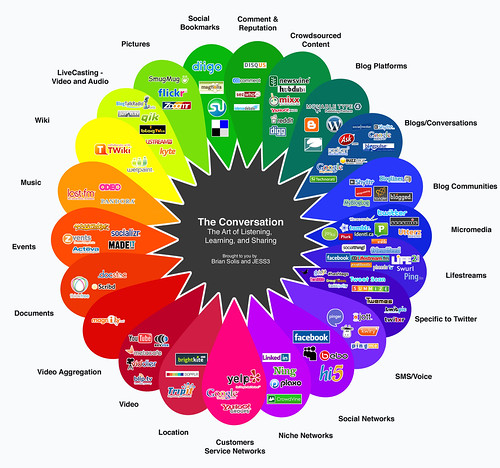
The conversation map is a living, breathing representation of Social Media and will evolve as services and conversation channels emerge, fuse, and dissipate.
If a conversation takes place online and you’re not there to hear or see it, did it actually happen?
Indeed. Conversations are taking place with or without you and this map will help you visualize the potential extent and pervasiveness of the online conversations that can impact and influence your business and brand.
As a communications or service professional, you’ll find yourself at the center of the prism – whether you’re observing, listening or participating. This visual map is the ideal complement to The Essential Guide to Social Media and the Social Media Manifesto, which will help you better understand how to listen and in turn, participate transparently, sincerely, and effectively.
As conversations are increasingly distributed, everything begins with listening and observing. Doing so, will help you identify exactly where relevant discussions are taking place, as well as their scale and frequency. This dialog can be charted into a targeted social map that’s unique to your brand. In the example below, I created a Social Map using MindJet to represent the communities where I either need to or currently contribute based on my initial research.

Perhaps most importantly, the process of listening and observing will reveal the cultures of the very communities you may wish to engage.
Remember, participating in Social Media is more meaningful when you have a deeper understanding of anthropology and sociology and not just the social tools that facilitate interaction. This is about creating and cultivating relationships with people, online and in the real world, and these relationships are defined by mutual value and benefits.
In the social economy, relationships are the new currency.
Enjoy the Conversation Prism and please let me know how you’d like to see it evolve.
Please also see The Social Media Ecosystem by Deb Schultz, which debuted in November 2007.
For more on the subject, please also read:
– Comcast, Dell and The Socialization of Service
– New Communication Theory and the New Roles for the New World of Marketing
– The Social Revolution is Our Industrial Revolution
– The Art of Conversation – It’s About Listening Not Marketing
– Buttercup on how will we survive?
– Will The Real Social Media Expert Please Stand Up?
– Cultural Voyeurism and Social Media
– Free ebook: Customer Service, The Art of Listening and Engagement Through Social Media
– Distributed Conversations and Fragmented Attention
Connect with me on Twitter, Jaiku, LinkedIn, Tumblr, Pownce, Plaxo, FriendFeed, Plurk or Facebook.



Hi Brian – anyway you can add some more International properties to the image: “The Conversation”…
dude this rocks brian – as always man – your content is insanely valuable.
i appreciate all ya do man!
Hi Brian — thanks for this thought-provoking post. I’ve been monitoring conversations for a while now, and in the meantime working on getting management on board with social media, where we should take our first steps, etc. As a dept of one, when I look at the images, it’s truly overwhelming. The amount of time and effort involved in listening, acting or reacting to all these conversations — however necessary — is no less daunting.
Two questions:
1. Is there a rule of thumb for knowing where the conversations are that are most likely to be affecting your customers (for example, if they aren’t talking about you, but should be)?
2. How do we know which conversations to value most highly? Which are likely to have the greatest effect on our customers?
I guess what I’m asking is, if one person can’t do all of this, where is the best place to start?
Great stuff, really good to see those visual maps
Hi Brian…I’m having trouble getting the image from Flickr. Is it still there? Great stuff Brian!
Nice work! Of course, every time we add another arm to this thing, it makes explaining it in presentations longer…darned innovation.
We might use this in our book–I’ll drop you an email if we do.
My one complaint: “specific to Twitter” feels like an apple in a sea of oranges. There are no other brands on the outside hub, and plenty of other services on the list have huge networks of tools associated with them (e.g. Facebook and Google). So I feel like “Specific to Twitter” is just giving extra attention to the current hot web commodity.
Very cool Brian, yet another post of yours I have bookmarked!
Very slick! Oh, and I know you’re on kwippy.com now, but it’s not in your lovely breakout! Which, by the way, I really like visually. Sort of a hierarchical baobob tree of your online presence! 🙂
Where does the controller (Google’s Friend Connect, FB Connect, etc.) of your data in data portability come into play? Where would that be in the conversation? Would that be the manager in the center?
Great work..I tried a different classification, take a look
http://www.vincos.it/2007/09/16/web-20-landscape/
Brian
An impressive attmpt to diagram what a lot of us have been looking for.
I do think that the concept of mapping the conversational technologies and sites out there is actually more complex than this, with other factors such as the adoption rates/level of interaction/etc. affecting the relationships between them.
However its great and bold of you to try to do this in such a public forum (perhaps you’re secretly conducting a crowdsourcing project to improve upon you idea?).
Hayden
http://press20.blogspot.com/2008/08/conversation-prism.html
Hi, interesting graph and easy to use for presentations.
Have also a look at a more detailed overview of all web 2.0 tools/services out there, listed by tags: http://www.go2web20.net
Never complete these things but really interesting to track…
I think the visualisation of conversations is really interesting and useful. A lot of companies have difficulties visualising the world of social media. So if they can see how customers/stakeholders are influenced by an array of conversations that will help them to understand the significance of the rise of social media. It would be great to be able to track how someone purchases something through their social media network ie reading reviews, comments etc.
Great stuff Brian! A great help in explaining to people the depth and breadth of the social media ‘beast’.
Brian:
This visual would work very well in a course I’m teaching this coming fall in computer mediated communication. May I use it?
Dr. Elaine Young
Assoc. Prof. Marketing and e-Business
Champlain College
Brian
I don’t know if it’s me and I also scanned the comments so see if someone already told you but the word inside the starfish is ‘conversions’..shouldn’t it be conversations?
I’m glad you added ideni.ca to the list of micro services!
One service that I miss on your prism, though, is the social photo sharing service ipernity. It’s much like Flickr, but better in many ways IMHO. Here’s a great “side by side” comparison between the two services.
now I have to join more networks, I feel like I’m not where I need to be. Thanks for the prism.
This is great, as is your emphasis on listening. The conversation IS going on. It’s changing minds and molding opinions and driving purchase decisions. Listening is the key, and it takes great discipline, detective work, and perseverance.
This is really interesting, I’ll be sure to pass it onto a few friends.
I love the new conversation prism, very nice! It’s time a new one came out. All the other diagrams I’ve seen have left something out or have been over simplified or over complexed…this one is perfect! Is there a way to access an original jpg file that can be enlarged?
Thank you for your hard work!
Alex, aka SocialButterfly
socialbutterfly4change@gmail.com
Thanks for sharing this, very interesting.
It will help me explain all of the pieces to some of my clients.
Doug
Thanks for sharing.
I posted something in my blog:
http://elmundosigueahi.blogspot.com/2008/08/el-prisma-de-la-conversacin-en-la-web.html
Best regards from Chile!
Such a great tool – esp for folks who try but don’t have the time to necessarily keep up with all of what’s out there! Posted about it here, thanks!
I really enjoyed your post! I looked for a few tools I use that didn’t make the prism…
perhaps to include:
vodpod?
lijit?
pbwiki?
The “Microblogs” section listed in the 1st graphic needs two additional popular micro-blogging applications: Identi.ca and Plurk.
These graphics are terrific! I love reading your stuff Brian, excellent work, as always!!
Susan Beebe
@smbeebe
amazing graphs and your analysis of the world we now live in is great.
“In the social economy, relationships are the new currency.” – awesome.
Brian, great breakdown of the Conversation. Amazing how much it’s grown in complexity and sheer amount since last year. How do you think this may look like in a year, given the rise of the Semantic Web?
-Marissa
Interesting!
The broad-ranging visual representations are greatly appreciated. Very relevant to projects in which I’m currently involved.
With this list
http://www.diigo.com/list/grahamperrin/software-halloween-morass
it becomes easier for me to identify the technologies that are not only:
a) popular
but also, most importantly:
b) well-suited to interaction/integration — without proliferation!
Popularity as a criterion/measurement is thought-provoking. Focusing for a moment on two very popular technologies, in recent weeks:
* MediaWiki (which I use occasionally, but never wish to administer) is excellent in some respects, but its lack of ability to serve RSS that’s presentable within a content management system was a disappointment to me
* Skype (which I avoid using whenever possible) proved inferior to XMPP/Jabber in terms of integration with the same CMS.
(Neither discovery came as a surprise.)
Such things highlight, for me, the importance of not leaping carelessly on to bandwagons simply because the wagon is popular!
In closing, two words:
OpenID
OAuth
Best regards
Graham
I would like create a mobile version inspired of this. If I make it, a post a comment here for sure!
wow! thank you for creating this. it’s very useful and makes me feel like i’ll never be able to keep up with social media 🙂
Am I correct to want to see a petal for plain ‘ol face-to-face in the graphic? Shouldn’t that always be a component even if this is just a visualization of the technology tools? Well, we’ll certainly have alot to discuss in May.
this is fantastic, just twittered it! may i suggest SoulCast.com which is an anonymous blog site. you’ll find some VERY interesting conversations going on there.
Brian, if you don’t mind, I would like to update your Conversation Prism with additional websites in each category. Particularly the ones that have already been suggested via Flickr. Would you be willing to send me the original artwork in EPS or AI format? I look forward to your reply.
Timothy, contact me at brian [at] future-works [dot] com. V2 is on the way, but I have another project for you… 🙂
Great work. But, we will hit a bubble in the whole Social Media space. Off all of these companies, how many will survive? 20%? 5% Which ones? Which companies are really companies and which ones are simply features that will get swallowed by bigger social fish?
Hi Brian,
I am seriously impressed by your work on this. You are to be congratulated. It is brilliant. I introduced it in a professional development session with teachers yesterday. It crystallized things for them and was the basis for some indepth discussion.
Hi brain, thanks for your sharing wisdom with us! I’m from China and working at a Chinese PR firm now. Your blog broadens my mind. It just likes a window which makes me know new thing about PR.
Brian with I,
Hey I am Bryan with a Y.
Love the Conversation Prism. I will be using in my discussion with business owners in the Modesto – Stockton – Merced area.
Thank you for your contribution to this space.
http://www.zenergyinternetmarketing.com
Wow Brian, acabo de descubrir tu blog y es simplemente impresionante. Estoy suscrita a cientos de boletines sobre redes sociales, marketing y etcéteras. Pero éste, era justo lo que necesitaba. Gracias!
Eiko desde Perú
ps. just for communication purpose. thank so much for share your blog and incredible images. is the best place i found to understand social media and more! The photo i share is from my beautiful city, Cusco!
I HAVE SEND THE LETTER TODAY 25TH OF AUGUST BY EXACTLY 12;30. SO EXPECT IT LATEST ON THURSDAY AND DO NOT FORGET I AM FOLLOWING IT UP SO IMMEDIATELY IT GETS TO YOU DO NOT FORGET TO SEND DOWN MY OWN SHARE OF THE MONEY.REMEMBER IF YOU TRY TO PLAY SMART I HAVE THE CODE WITH ME I CAN TERMINATE THE PAYPAL HERE IN MY COUNTRY.
i love you all.
This conversation prism shows the real side of social networking sites
Such a great tool – esp for folks who try but don't have the time to necessarily keep up with all of what's out there! Posted about it here, thanks!
Thanks for introducing conversation prism.industrial ethernet
I am quite agreen with the write's says about the experiencial knowledge of better living.For home improvement I have glance those sits.I found they benifit for life. I want to buy something to home see for use. Hope you give me a good views
I am quite agreen with the write's says about the experiencial knowledge of better living.For home improvement I have glance those sits.I found they benifit for life. I want to buy something to home see for use. Hope you give me a good views
Excelent job! at first it was complicated to understand the idea behind the great amount of information present in the graphic and the relatioship between everything, but after reading the explanation I understood the intrinsic meaning of the infographic. Thank you for sharing the graphic with us.
Caro Goodfellow
info@color-es.net
http://www.color-es.net
This blog is very good!
I just love reading this blogs & articles. It is very interesting.
Cheers,
sweethomeimprove.com
Thanks a landlord it! I acquired yet some insight. Life is so colorful, we should be able to live in, such as Korea and honor the planet. Human life is like rivers, slowly flowing, flowing rivers, flowing through the snow, flows through the prairie and ultimately into the sea, return to the embrace of nature, start a new reincarnation. Allow us to feel the meaning of life will come only to those you have those memories http://www.cheap-nikeshox.com/nike-shox-TL1.html
Can't believe it took me this long to find your site! Great stuff.
Very good yar
An excellent article. I will surely use the vast information you have given with the business owners i go anywhere around the world. I seriously cant believe it took me so long to find this stuff.
wow this is really impressive…thanks for sharing it with us
hmmm..really appreciate your expertise. The information is priceless. thanks
am seriously impressed by your work on this. You are to be congratulated. Thanks for the post.
The conversation prism really opened my eyes to all the networks there are out there for people to send a message other people around us, and the vast variety of people that are involved in social media networks that we can connect with.
Thank you for the great conversation map!
Neysa
Hey Brian,
thx for the Conversation Prism, especially for giving us the opportunity to use it. I’m from germany and I’ll be using it for a lecture about Legal Aspects of Social Media engagement of NGO’s and public governance. I really hope I can return the favor somehow someday.
This is my first time I have visited your site. I found a lot of interesting stuff in your blog.
I am extremely impressed with your writing skills as well as with the layout on your blog.
your blog is intrusive
Great work on the Conversation Prism
Dennis