
Credit
Bernardo A. Huberman, Daniel M. Romero and Fang Wu of the Social Computing Laboratory at HP Labs conducted an in-depth study of the relationships that power Twitter. The team recently released its report, “Social networks that matter: Twitter under the microscope.”
The abstract:
Scholars, advertisers and political activists see massive online social networks as a representation of social interactions that can be used to study the propagation of ideas, social bond dynamics and viral marketing, among others. But the linked structures of social networks do not reveal actual interactions among people. Scarcity of attention and the daily rhythms of life and work makes people default to interacting with those few that matter and that reciprocate their attention. A study of social interactions within Twitter reveals that the driver of usage is a sparse and hidden network of connections underlying the “declared” set of friends and followers.
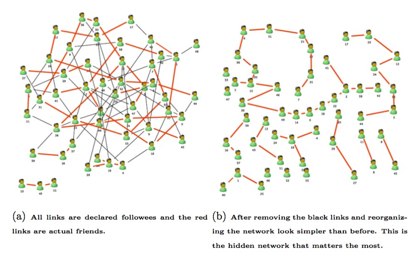
The paper captures the definition of online relationships in the Social Web and why they are inherently ambient and not intimate as opposed to those we maintain in the real world. In life, we embrace those relationships that are mutually beneficial and not necessarily one-sided.
In social networks, however, many factors are present that impact the social graph as well as the ebb and flow of information and ultimately dictate what becomes a top trending topic, who garners relative authority, and also what goes viral.
According to the report, “A link between any two people does not necessarily imply an interaction between them. As we showed in the case of Twitter, most of the links declared within Twitter were meaningless from an interaction point of view. Thus the need to find the hidden social network; the one that matters when trying to rely on word of mouth to spread an idea,
a belief, or a trend.”
The intentions of Social Networks and Micro Communities (such as Twitter) were genuine and innovative as they attempted to improve communication, sharing, and connectivity between friends, family, associates. The new social economy also aspired the building of bridges between the previously disconnected and interspersed relationships that join friends of a friend (FOAF).
What has evolved however, is so much more than the connection of friends and friends of friends. Social Networks have created a parallel friend/follower archetype that injects a homologous top-down network where individuals not only connect with those they know, but also with those who are interested in following their online activity, and not necessarily with the expectation of reciprocation. This injects a new dynamic into online social relationships, one that facilitates and fosters a less personal, but still meaningful engagement, creating an ambient, persona-audience interconnection.
In an attempt to measure influence while revealing relationships on Twitter, Benedikt Koehler developed Twitter Friends. Koehler’s application is by far the most compelling and valuable analysis tool for measuring the @-crowd or “the relevant net,” those people that any given user converses with most often.
He observes, “The number of people you follow on Twitter is not the whole truth. It’s more interesting [to see] who you are talking to whether you are following them or not. It [is] not a connection-based network but a performance-based network.”
Revealing the Hidden Network – The Outbound Relevant Net
Using TwitterFriends to visualize the outbound relevant net for someone, in this case me, on Twitter, here’s a snapshot of those I most recently conversed with in the public timeline:
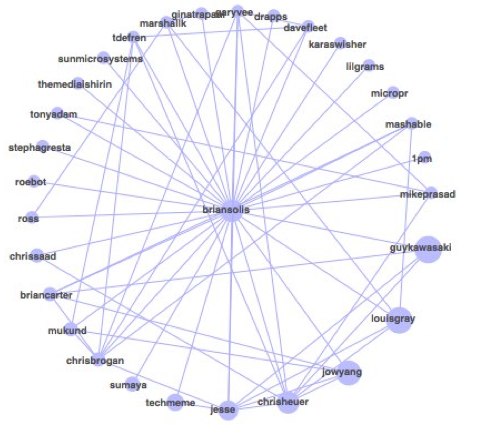
This is what’s called the “Hidden Network,” but it’s not representative of the whole story. This map merely represents a moment in time where context and related events connected individuals and therefore formed a transient first-level map of contextual relations or conversations.
The Inbound Relevant Net – Public Conversations @username
The followers and followers of followers that consistently, and loyally, RT, @, promote, or cite (tweet) excerpts of content related to a particular username is a far more compelling revelation into the true influence and authority of a relevant network – one that is powered by both parallel and divergent factors associated with outbound conversations sourced from the host ID.
Using TwitterFriends to visualize the inbound network as it relates to @briansolis, let’s compare the corresponding map to that of the Relevant Net above:
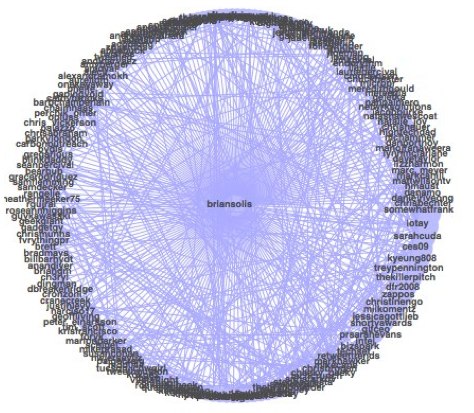
Both reveal valuable information as they transform hidden networks into visual maps of contextual relations and associated influence for deeper analysis. But to assume online social influence or connectivity is limited to only the above networks, incoming or outgoing, is insular.
Contextual Networks
I suggest we inject another dynamic into the equation, one that in my opinion, weighs more than the conversation quotient that measures the hidden network of those you (or any username) message in public – whether inbound or outbound. Whether or not these conversations are intended to elicit a response directly from a source or @username, the orbiting dialog around a particular person and the topic of conversation is paramount. We’re seeing this increasing level of shared behavior in the practice of RT (retweeting) on Twitter or “liking” on Facebook or Friendfeed. The public sharing of relevant content introduced by any given individual sparks conversations across social graphs with or without the formal participation of the original contributor. This exchange changes based on the content that’s introduced to the public.
This is what I call the Influence Factor (IF). It is a related network that connects second, third-level and sequential friends and friends of friends (FOFs) that are bound by topic and time.
The Backchannel
Perhaps the most accurate Relevant Net that truly documents actual relationships is The Backchannel – those individuals whom someone directly engages behind the scenes.
This additional, but no less relevant, hidden phenomena is the explicit exchange of content, a private request, or an implicit action that catalyzes the sharing of information, content, or ideas across multiple, distinct social graphs to directly influence and catalyze the friends of those trusted social beacons as well as the progression levels of the friends of friends effect.
The Social Economy
In day-to-day online conversations, content exchange and reciprocity are the currencies that finance the Social Economy. This entire discussion is true and constant whether focused on Twitter or traditional social networks such as Facebook or MySpace.
A social network is not necessarily bound by relationships as much as it is driven by the exchange of shared ideas and information through a one-to-one and one-to-many conversation that is inclusive of top-down, bottom-up, inside-out, and outside-in peer-to-peer interaction.
Many of us forge relationships and engage in online conversations unlike those we maintain in the real world.
The Ties that Bind

Source
We’re bound by context and it is under these circumstances, the relevant network actively transforms in each of the scenarios above.
The ties that bind us together in online networks aren’t intrinsically dictated by people, but instead by constant as well as shifting contextual themes that unite us. It forms the foundation for a different dynamic for engagement and a new definition of relationships.
The individual social graph is then networked by the common interests of people as they relate to specific dialogue over time and also in the moment, and thus, it’s always expanding and contracting. We identify uniquely with different individuals across varying topics. A true social graph and the relationships that define it are constantly influx and measurable only as snapshots tied to subjects frozen in time.
It is for this reason, that we should also create and analyze contextual maps based on the themes that bring us together.
Therefore keywords, not necessarily those conversations we host or “@” in aggregate, are the primary research criterion when analyzing the connection and interaction between individuals and groups to more accurately identify and chart a “contextual map” that visualizes the distinct relationships united by commonality, affinity, and/or loyalty.
Viral marketing, videos, content, “insert keyword here,” as governed by an identifiable and formulaic process and Relevant Net, technically become myths. It’s people and their shifting network of relationships combined with the extended reach of their contextually-based friends’ networks that can make something viral or make someone influential within specific social realms.
Everything starts with listening and observation – a bit of digital anthropology if you will – in order to assess and understand diverse cultures, relationships, behavior, and dynamic influence, as well as the migration and impact of content, across the relevant net.
A connection-based network now also becomes a performance-based network. But metrics, maps, and hidden networks aside, the culture of social networks is cultivating a new breed of influence and connections that tie us to more than those we know in the real world, but also those whom we connect with because of what we represent through our online personae.
How does this change how you view and manage important relationships if at all?
Connect with Brian Solis on:
Twitter, FriendFeed, LinkedIn, Tumblr, Plaxo, Posterous, or Facebook
—
Click the image below to buy the book/poster:


pr pr+2.0 pr2.0 public+relations marketing advertising interactive social+media socialmedia brian+solis social media media2.0 media+2.0 2.0 smo social+media+optimization marcom communication publicity advertising expert interactive spin brand branding guru social+architect


That’s a very interesting read Brian, I’m a big fan of network analysis.
Its a complex subject to say the least, but other areas of investigation that would interesting would be related to geographical influence.
Taking into consideration that most people whom are in that original strong network are likely to be people you’ve met and therefore most likely to be people are relatively local to you.
Also, perhaps on the IF front, what effect the “power” of users (in the case of Twitter the number of followers is probably the best metric) has on the relative likelihood of a message being RT’ed. In effect establish whether a message from a “powerful” tweeter always holds more networking power, irrespective of quality of content.
Thanks for the post, it was very interesting to read.
Ed, excellent thoughts. In concur. I’ve studied geographical influence and indeed there’s a strong correlation. Re: RT, I’m working on that piece soon. A strong following reduces the amount of grassroots marketing associated with promoting content.
This is just a very smart, overhyped way of analysing the principle of Twitter. We as indiviuals become used to one set way of communicating to each other, progressing from email to instant message, then through a more open space in the collaborative social networks such as Twitter The idea of analyzing in such great detail the simplicity of following someone on Twitter confounds me beyond belief, and brings into question if this study serves any greater purpose then that of justifying the use of social networking to a higher academic, perhaps more lesser connected audience!
Hi Brian,
Thanks for posting. I am curious to see how different the network looks when a person is tweeting versues a corporate “marketing” feed.
Hi Brian,
You requested feedback when you tweeted this, so here goes…
* I love the highly analytical, academic approach. I think it’s actually time that someone like you, who’s entrenched in the world of social networks, attempts to explain the phenomenon and underlying complexity behind this seemingly very simple interaction.
* I would love to see more manifested examples of exactly what you mean when you refer to the backchannel, and how exactly you define IF. I can take some guesses, but I’d rather understand your definition.
* You say, “It’s people and their shifting network of relationships combined with the extended reach of their contextually-based friends’ networks that can make something viral or make someone influential within specific social realms.”
How, then, does someone capture this? How have you? Is it formulaic, something you can pinpoint, or is it intuitive?
Looking forward to more!!
-Susan
Hi Brian,
Excellent! Reflecting on your post, I’m not really seeing a major change in the way I view my SM relationships at this point in time. However this could change if I decide to actively promote a product or pov and/or if I am ever able to accurately analyze and project my personal “connectivity reach” in real time for marketing purposes.
Thanks,
Jenifer
It’s an interesting subject but I’m not sure what the value is in these types of analysis of networks. I know there are a lot of people that I have strong ties with that wouldn’t show up in any of these types of analysis. I know who they are. Why should anybody else know who they are? If I don’t need network analysis to figure these things out then who exactly needs/wants this information?
Looking at a twitter account and analyzing depends on the age of the user and how long they have been on twitter. Experienced twitters use it much differently then newbies. The younger generation will use it differently then a corporate salesman. A blogger or facebooker will use it differently then a true twitterer.
Right now I see a lot of people leaving email (spamming and sluggish delivery) and experimenting with several sources of communication.
Hi Brian,
I think the article is rather interesting, especially for a beginner in the new media landscape like me. However, please help me understand something because I am having some trouble with a couple of the terminologies.
For the Outbound Network, this is referred to as people we recently connected/conversed with at a particular point in time. This is, as the graphic on your blog showed, the first level mapping of the relationships. I understand this cluster of concepts, but I’m thrown by the Hidden Network title. Why is it considered hidden? Am I missing something here?
Moving on to the Inbound Network, once again, I understand the broad concepts of how one user sends out content, and the degree to which his/her content generates buzz among the net community and causes the content to “ping” among the primary, secondary and tertiary networks – which is indicative of the level of content leadership, or, in your words, IF. Once again, I need some help to reconcile the ‘Inbound Relevant Net’ tag to this cluster.
Can you, or anyone, help to shed some light? Are these (Inbound, Outbound and Hidden Networks) indigenous or sensitized concepts?
Also, Ed, when you talk about strong networks, is this analogous to the strong and weak ties that are used to describe social relationships?
Hope you’ll all indulge me in my questions cuz it’ll really help to get me up to speed in this arena.
Thanks all!