
The Social Web is maturing at a blurring pace, packing thousands of years of behavioral and social evolution into the span of ten years or less. Social Media has amplified our individual voices and introduced an infrastructure that connects us contextually across a myriad of social networks. We’re conditioned to participate and engage genuinely and transparently in order to foster meaningful conversations and ultimately relationships.
I’d like to explore the other side of the discussion that rarely sees the light of day, if for no other reason than to serve as a reminder that we can always learn how to do things better.
Deb Schultz has a very wonderful and poignant saying, “technology changes, people don’t.”
For the most part, I agree with the premise that technology will always change and that individuals will always stand behind the avatar defining unique online personae with every update. But people do evolve.
I too have shared my observations that we continually find ourselves intertwined in the discussions about shiny tools and services and forget about the cultures that define the communities that lure and captivate our attention. It’s a bit of sociology mixed with psychology and a dash of ethnography for good measure.
In the end however, human nature is human nature. We always change and adapt to our surroundings, both natural and man made – at least we’re supposed to.
The blogosphere provides us with a platform for unbridled self expression. Social networks facilitate interaction around content and unhindered dialogue. Social objects serve as catalysts for activity. Micro communities spur the rapid exchange of information bursts.
With every new post, update, tweet, upload, comment, like, and link, we share a little bit more about who we are and what we stand for. This works for and against us.
In the era of the socialized Web, we’re empowering a new era of personal recognition and fulfillment that extracts an unconditioned human response and shapes its unpredictable course and behavior over time.
In some cases we’re rewarded with new friends and followers, links, retweets and posts. In other circumstances we lose connections and stature. But when we can immediately visualize and benefit from the gestures that share and promote our online identity, we’re seduced by the overwhelming and addictive sensations of finite acceptance and prominence – if for but a moment in time.
What’s unfolding is a relentlessly shifting pyramid of online social hierarchy that redefines the notion of friends reinforced by how view our place in the statusphere.
According to Dr. Dunbar, the size of the human brain allows a stable network of about 148 contacts, which has become known as “the Dunbar number.” But, this isn’t about the relationships we’ve come to know in the real world. Certain individuals follow and are followed by thousands or hundreds of thousands of “friends” across the Conversation Prism. This is a new breed of personal branding tethered to a peer network that flirts with fandom and creates an alluring sense of micro celebrity. And, we may or many not even know or ever know the people who choose to follow our updates or friend us on these popular and emerging networks. Relationships aren’t measured. Instead, we’re focusing on the quantity of connections, the number of links, grades based on the reach of followers, and the volume of updates and links back to them.
Unknowingly, we’re grooming a new generation of status-fueled socialites.
We’re becoming important in our own domain, one that knows no borders, and it’s blurring the lines of how we behave when we step outside of it. It’s the constant struggle between who we are online and who we are in real life and it serves as an inflection point for who we ultimately become.
Transparency is the ante to participate on the social web. Social capital is the payoff. Conversations serve as the currency. But does the act of practicing transparency change how we behave online, over time? Tolerance and patience is finite for self-promotion, eventually motivating followers to distance themselves from those who continually evoke the “me” in Social Media.
As the community swells around us, we adapt to its essence. We gain confidence through feedback and responses and each reply and comment. We bask in this new found influence and are obsessed with ensuring an increasing cadence of interaction. Some remain grounded while others immerse themselves into the never-ending chase of Internet fame and intellectual fortune. Either way, we’re forever impacted by the sweet taste of significance that was previously only attainable by an elite few.
In the process of adapting and cultivating personal communities, we lose a bit of who we are and adopt an aura of who we want to be.
But, even rockstars need managers. Even celebrities Need publicists.
They’re counsel guides them through unfamiliar paths to stardom and relevance to fabricate a legacy that dictates begets promising opportunities and established future reference and inspiration in the process. In a sense, these roles potentially save them from themselves, ensuring that these celebrities maintain a tenor of enticement and seduction that’s just far enough out of reach from the rest of the world, while still appearing human. While social networks encourage a genuine participation, we’re currently witnessing the effect living a detached life has on people skills and the ability to host true dialogue.
Sometimes power and influence is corrupting, unraveling the very fibers that define our character.
Personally, I believe that the true promise of the social web is the ability to learn through listening, observation and mutually beneficial interaction and its effects and lessons reverberate and educate in the real world. The information renaissance currently underway is governed by the selfless act of sharing and collaborating and the art of reciprocity. Always pay it forward and never forget to pay it back. It’s how you got here and it defines where you’re going. This is how we can build a strong and flourishing community and maintain integrity and personality without losing who we are.
In the end we’re measured by our actions and not words. We earn the relationships, trust, and reputation we deserve.
The constant search and dedicated activity to narrow the gap between who I am and who I want to be serves as my catalyst to participate and learn each and every day.
Helpful Posts on PR 2.0:
– The Social Effect
– The Conversation Prism 2.0
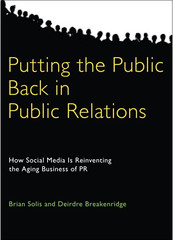
– Putting the Public Back in Public Relations is Now Available
– Twitter and Social Networks Usher in a New Era of Social CRM
– The Human Network = The Social Economy
– In the Statusphere, ADD Creates Opportunities for Collaboration and Education
– Humanizing Social Networks, Revealing the People Powering Social Media
– Are Blogs Losing Authority to the Statusphere?
– I Like You
– Tracking Brands on Twitter to Improve How You Listen and Engage
– The Ties that Bind Us – Visualizing Relationships on Twitter and Social Networks
– Make Tweet Love – Top Tips for Building Twitter Relationships
– The Battle for Your Social Status
– Twitter Tools for Communication and Community Professionals
– Is Twitter a Viable Conversation Platform
– Is FriendFeed the Next Conversation Platform
– The Social Revolution is Our Industrial Revolution
– The State of Social Media
Connect with me on:
Twitter, FriendFeed, LinkedIn, Tumblr, Plaxo, Plurk, Identi.ca, BackType, Social Median, or Facebook
—
Subscribe to the PR 2.0 RSS feed.

—
Now available:

—
pr pr+2.0 pr2.0 public+relations marketing advertising interactive social+media socialmedia brian+solis social media media2.0 media+2.0 2.0 smo social+media+optimization marcom communication publicity celebrity web internet famous personality sociology enthnography psychology relationship conversation brand personal persona science community blog blogger fame



Social media doesn’t change how people communicate. It reestablishes it.
Before the advent of mass communication, people communicated in small communities around the marketplace, which is still true in third-world countries and minority neighborhoods. People knew everything about everybody in the community within a day and social conformity developed according the the personality of the small community.
With the invention of movable type made it possible for people to store concepts in something other than human memory and pass them to more people, growing the virtual community, but at the same time, it helped enforce a larger “group think” because those who controlled the media could establish the format of the discussion. As print became ubiquitous, more communities formed around particular publications.
Radio and Television, however, made it possible to isolate yourself from the print community. It was possible now to get information on a global scale and ignore the local community.
Social media has brought us back to the marketplace, but at the same time isolates us from the worldwide community. This time, our village is electronic and can include people from multiple geographic locations, but still establishes social behavior described by the group. It is more efficient, but more limited in scope.
This is really a beautiful and thoughtful post, Brian. It’s one of those blog entries I’ll print out and save to remind myself of the points you make on human interaction. Although you aren’t a sociologist, you point out so many valuable insights that strike me as accurate.
Just two thoughts:
1) I think human nature does change, especially if you take a long-term view. But this change isn’t uniform, it is usually culturally specific, it doesn’t occur at the same rate with every individual and it is usually in ways that we can not predict. At best we can try to understand the present and see how we got here but even those interpretations are better made 20 years after the fact, when we have some hindsight.
2) I’d disagree with this statement: “Instead, we’re focusing on the quantity of connections, the number of links, grades based on the reach of followers, and the volume of updates and links back to them.”
I think the “we” you are talking about is actually a very narrow range of social network users. If you look at Hubspot’s latest blog post, you can see that the vast majority of the Twitter users they track have a medium-sized social network (~600 people or less). The “we” who are keeping score, obsessing about their rank are a small minority of users but they take up a lot of space, so to speak. They are really competing against each other not with the typical Twitterer who doesn’t care who has 20K, 50K, or 100K followers.
I did an informal poll where I asked people where they found names of new people to follow. Those ranking sites fell far, far down on the list. I’m beginning to think that only the people who are on them (or who want to be on them) pay attention to ocial network rankings. I’ve even run into people saying that are unhappy to get bigger numbers of followers because it makes keeping track of people more complicated.
Our view of the world is always colored by the opinions of the people we are in conversation with. They are our reference group. Broaden that circle of people and you’ll see social networks in completely new ways.
Thoughtful post, Brian. (Plus, the picture is beautiful.)
Maybe it’s just my pre-coffee mood, but it feels like this post could use more time to gel. It strikes me as less focused than your usual posts.
At one point you write, “we lose a bit of who we are and adopt an aura of who we want to be.” It seems like your point here is about the personal cost of “transparency.”
Yet you close with this lovely and touching bit: “The constant search and dedicated activity to narrow the gap between who I am and who I want to be serves as my catalyst to participate and learn each and every day.”
It’s the same concept, imho.
I guess my comment about those two quotations is: this is the heart of your thesis, and it’s strong and thought-provoking and worthy. But, it’s buried. So much so, in fact, that I’m distracted by some of the other (engaging) points around it. I’m inspired by what you’re saying; so I’m wanting it be in starker relief.
But, now that the coffee is setting in, another comment is demanding I give it voice.
The emotional price we pay for expressing ourselves in a truly honest, authentic way (is this what you mean by “transparency”?), is the same struggle faced by every artist. Artists hope to express themselves authentically in their art — and they pay a price for that (exposing vulnerabilities to criticism can be emotionally draining). But they also reap the incalculable benefit of self-realization (and sometimes even “the overwhelming and addictive sensations of finite acceptance and prominence”).
You write: “Transparency is the ante to participate on the social web. Social capital is the payoff. Conversations serve as the currency.”
How do you react to this: “Authenticity is the ante to engage in artistic endeavors. Self-realization is the payoff.
Dedicated artistic activities serve as the currency.”
How is what you’re writing about here similar to the life process of artists?