Last year at SXSW, Foursquare founder Dennis Crowley joined Frank Eliason (previously @comcastcares), Altimeter Group’s Jeremiah Owyang and me on stage to discuss the shifting landscape of social engagement. While I focused on the sociology of engagement and the impact it is having on culture and society, I also sought to balance the conversation by demonstrating the impact of digital actions and interaction between people and businesses. Whether intentional or not, Crowley and team unlocked the elusive gates that separated…
Rethinking the Future of Business Part 2: Building the Framework
In part one of Rethinking the Future of Business, we examined the state of social media in business. Once again, we take a look at a recent report published by Altimeter Group’s Jeremiah Owyang,”Career Path of the Corporate Social Media Strategist.” As part of a study on social media strategists and the divergent career paths that lie ahead, Owyang reviewed the social framework for socially renowned enterprise businesses as well as corresponding strategies and resources for 2011. The results says…
Rethinking the Future of Business Part 1: The State of Corporate Social Media
Whether you know it or not, the path that social media follows within the organization is in your hands. But as we’re learning, mastery of the latest social tools does not guarantee a place in the ranks of upper management let alone a place on the team period. The role of the social media champion is not timeless; in fact, the days of its designation are numbered. However, your role and the role of new media in your organization is…
The Time Has Come For Holistic Business Strategy
Guest post by Chris Heuer, Founder/Chairman Social Media Club What’s the biggest problem in business today? It’s not access to capital, though that is a real problem in that it inhibits growth in some places where it shouldn’t. No, it’s not command and control management hierarchies, despite the contribution they certainly make. It’s not the problem of “the other” that plagues broad swaths of our society, though that is a close second. I contend the biggest problem is that each…
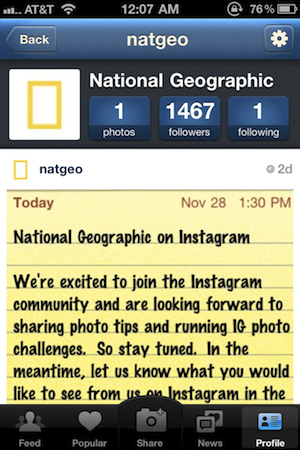
Picture This: When Consumers Have Questions, Do Brands Have Answers?
I pay attention to emerging technology and trends on a daily basis. While I track many networks, tools, and services, I take the time to share those that appear to gain traction or offer interesting prospects for tomorrow’s business, today. Two such services are quickly becoming the darlings of the blogosphere and brands alike, Instagram and Quora. Not a day passes us by where someone isn’t analyzing Instagram’s rise to imaging stardom or Quora’s domination of social engagement around questions…
On relevance and the need to earn it today and every day
If it’s one thing that I’ve learned over the years of studying social media, business, and the pursuit of influence, it’s that we are competing for the moment in order to earn and maintain a semblance of relevance. For businesses struggling to gain traction through Likes, RT’s, comments, clicks, friend and follower counts, the moment for which we compete, never really comes. It is perpetual. As I was thinking about this idea for an upcoming post, I paused when I…
At the Pivot of Business, Marketing and Media
I am certainly no stranger to the conference circuit. Over the years, I’ve helped many friends organize conferences, advised organizers on programming and positioning, and presented at or attended scores of others. It is at these conferences where I am fortunate to meet and support many friends and new friends alike while also learning from the wisdom of my peers. Nothing will change…I’m passionate about all of the above. But, I do have some news to share with you… As…
The Social Compass is the GPS for the Adaptive Business
Over the years, I’ve written extensively about the need to extend opportunities in social media beyond marketing and customer service to set the stage for the social business. I believe that the impact lies beyond the socialization of business; it introduces us to a genre of an adaptive business, an entity that can earn relevance now and over time by listening, engaging, and learning. In October 2009, I worked with JESS3 to visualize corporate transparency and authenticity for the release…
New Media and the Future of Business
I was recently interviewed by Israel’s BuzzInNews about new media and business. The conversation was translated from Hebrew to English, to share with you here as well. The discussion explores the evolution of social media in business from attention economics to B2B to ROI and concluding with a discussion of the brewing cold war between Google and Facebook. As an expert on New Media, could you provide an insight to what the difference is between New Media and Social Media?…
From Community Management to Command Centers
In early 2007, Chris Heuer, Shel Israel, Deb Schultz, Giovanni Rodriguez, and I explored the evolution of social media within the enterprise at an intimate business event in Palo Alto. One of the more memorable discussions focused on the rise of an official role within business to listen to social discourse and channel inbound questions and comments as well as official responses. The question eventually arose, how do we classify this new role within the organization? The designation of “Community…