CIO’s Matt Kapko recently explored why Apple’s social media strategy seems to play the game differently, according to its rules, and not the best practices of everyone else. We talked at length about it now and over the years. This time, I focused specifically on the question about why/why not have an @Apple account. Part of my thoughts made it into the final article, the rest is below for you to see. Excerpt: Apple does social media differently than its…
When You Share Experiences You Help Strangers Make Decisions
Whether you realize it or not, when you share an experience you have, whether it’s through a post, review, video, image, rant, praise, etc., it helps a stranger make a decision about what to do next. Customers aren’t following the customer journey you designed because they’re too busy hacking it. No matter how much journey work you do, no matter how creative your marketing, no matter how responsive your website is, no matter how much technology you invest in, customers…
![The 7 Success Factors of Social Business Strategy [INFOGRAPHIC]](https://briansolis.com/wp-content/uploads/2015/04/Altimeter_7Success_Factors_psd-1024x738.png)
The 7 Success Factors of Social Business Strategy [INFOGRAPHIC]
Over the years, my partner Charlene Li and I authored a series of research papers and also a short book on the evolution of social businesses, from philosophy to strategy to practice. Along the way, we also produced an effective maturity model and infographic that documented the six stages of social business transformation. This work would eventually pave the way toward my focus on digital transformation and innovation today. Now, after all this time however, I wanted to share the…

Becoming a Thought Leader in the Digital Era
Guest post by Dorie Clark (@dorieclark) is a marketing strategist who teaches at Duke University’s Fuqua School of Business. She is the author the new book, Stand Out, which is now available. It’s getting harder to communicate these days. Of course, the tools and channels are more ubiquitous than ever. We can blog or podcast or share sepia-toned Instagrams or racy Snapchats or funny Vines. But is anyone actually listening? With more noise and clutter than ever before, how can…

Insights: Interviews on The Future of Social Media as Curated by Anil Dash and Gina Trapani
I’ve long admired the work of Anil Dash and Gina Tripani over the years. In many ways, each has shaped my perspectives in new media and its impact on our professional and personal lives over the years. It came as no surprise that Dash and Tripani collaborated on yet another project. This time, they created ThinkUp, a social media service that offers daily insights about you and your friends on Twitter and Facebook. To celebrate the launch of their latest…

Social Business is the Sum of Social Media Marketing, Social Customer Service, Social Selling and More
Customers and employees are still underserved and underappreciated. Some would say, in business, social media lost its way. Others would argue social media failed to live up to the hype. There are unfortunately still many examples of businesses not getting it, viewing or outsourcing it as a mere “marketing” function, and operating in siloes where social becomes anti-social by design. Without purpose and collaboration, social will always be just another thing that businesses use to defer the inevitable…change. Even though…
Community is Much More Than Belonging to Something; It’s About Doing Something Together That Makes Belonging Matter
Viginia Coutinho is a dear friend who just released a new book (in Portuguese) that helps strategists think differently about social media. She is also the organizer of Upload Lisboa, a fantastic event in Portugal that focuses on innovation and disruptive technologies. Earlier in the year, she surprised me by asking if I would consider writing the foreword. Even though I don’t write much about social media these days, I couldn’t let her down. Now that her book is available,…

The Disconnect in Connecting the Workplace
There’s a lot of talk about the future of work… Technology is indeed connecting us in ways that improve communication, discovery and connectivity. The world is becoming a much smaller place as a result. Chances are that you are connected in one network or another to people in at least 12 other countries. Although social networking and smartphones are relatively new as a staple in the everyday life of adults and kids, how we as consumers use these networks and…
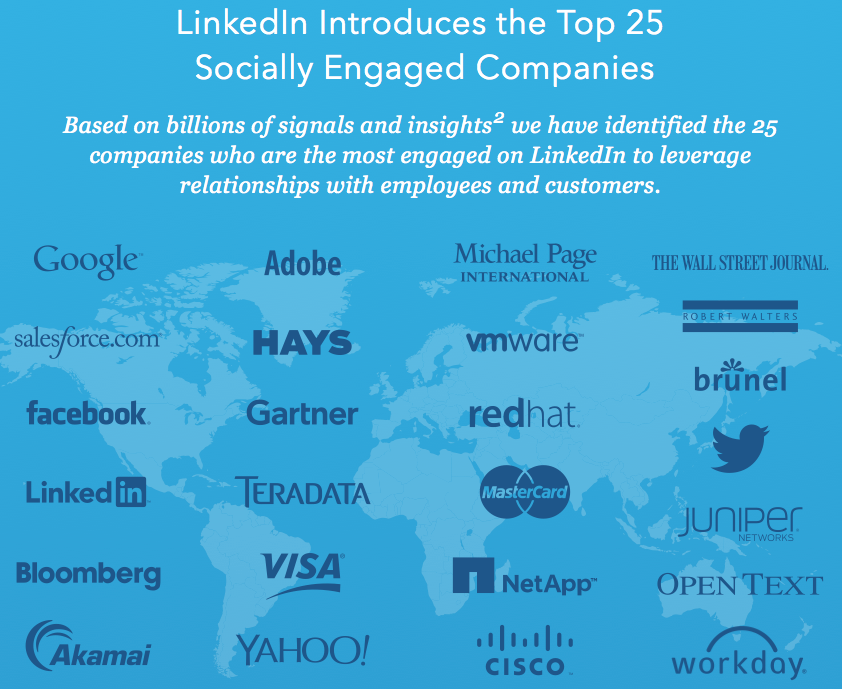
The Top 25 Socially Engaged Companies on LinkedIn Invest in Employee and Customer Relationships
LinkedIn and Altimeter Group published a joint report on the value of corporate social media and its role in customer and employee engagement. To do, we formed a baseline of companies that were actively engaged on a platform we could effectively study. After eight months of research, we assembled a list of the Top 25 Socially Engaged Companies based on how they use LinkedIn to engage employees and customers in the following areas: 1. Content marketing 2. Employee engagement 3….
Social Media is Lost Without a Social Compass
Marcia W. DiStaso and Denise Sevick Bortree recently published a university-level textbook to address an important topic by the same name, The Ethical Practice of Social Media in Public Relations. As they were wrapping up the editing of the book, I was asked to contribute the foreword. Upon reading some of the manuscript, the answer was, YES! Of course, I asked if I could share it here with you and I’m happy to announce that it’s included below… About The…