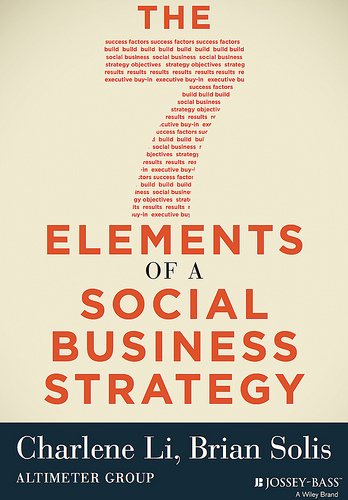
Recently, my Altimeter Group colleague Charlene Li and I published an ebook that revealed The Seven Success Factors of Social Business Strategy. To our pleasant surprise, the industry didn’t just react with positive feedback, but also with fantastic infographics that brought the core of the book to life. I wanted to share a few with you here. Over the years, we studied businesses endeavoring to master social media at various stages. We detailed our findings in our research report uncovering…
The Future of Marketing Has Little To Do With Marketing
While I don’t always have the ability to say yes to writing forewords, I do find time now and then to do so. One of the conditions however is that I’m allowed to share my thoughts, unabridged, with you here. The latest is for a new book, Share This Too, released by Wiley, the publishing house that I also worked with on #WTF, #EOB, #Engage. Thank you to my good friend Paul Fabretti for the opportunity… Without further delay, allow…
Will Twitter’s New Conversations Hinder or Spark Conversations?
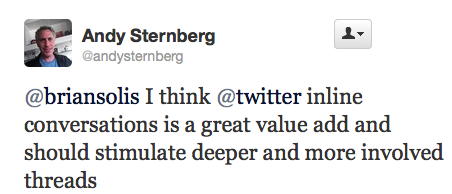
Twitter recently announced “Conversations,” a new feature that connects conversations via a blue vertical line. This new feature believe it or not has sparked a red line between love and hate. Ironically, this impassioned back-and-forth demonstrates the value of Conversations. For years, Tweets appeared in a reverse chronological order. Now, you can see connected conversations in chronological order within your normal stream to follow real-time dialogue. To follow deeper threads, Twitter includes a clickable link to instantly “view replies.” ABC…
5 important questions answered about the importance of social business strategy
Altimeter Group founder Charlene Li and I recently published a report that documented the 6 Stages of Social Business Transformation. In the process, we discovered the most common mistakes and successes businesses experienced along their journey. What was most surprising however, not really, was the cavernous disconnect between social media strategy and overall business objectives. – Only 34% of businesses feel that their social strategy is connected to business outcomes. – Just 28% of companies we studied feel that they…
Broadcast Yourselfie: How teens use social media and why it matters to you
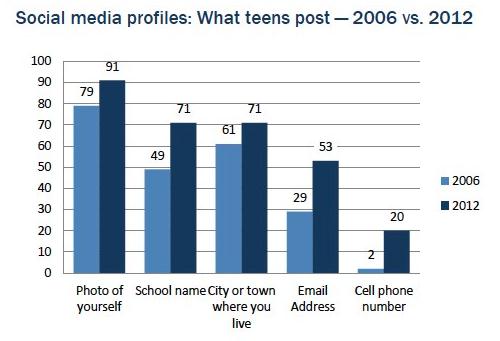
If you want to know the future of technology and its impact on society study how younger generations interact with one another today. With the sting of a face palm, you’ll experience a sheer rush of humility as you realize that everything you thought you knew about tech is simply nascent compared to the sophistication of digital natives. No matter how connected you are or how many followers or friends you have online, there’s a sense of artistry mashed together…
![The Accidental Narcissist And The Future Of [Connected] Customer Engagement](https://briansolis.com/wp-content/uploads/2013/08/selfie_-_Google_Search-1024x650.png)
The Accidental Narcissist And The Future Of [Connected] Customer Engagement
Have you ever noticed that your Facebook News Feed is the digital equivalent to “It’s a Wonderful Life?” Perhaps you’ve likened your Instagram stream to that of “Lifestyles of the Digital Rich and Internet Famous.” In each network, and across multiple social streams, you’re fed a visual buffet of seflies, travel, food, fashion, and celebrations. In assemblage, they tell the story of life well lived, or at least a life well curated. At the center of each of these experiences…

STUDY: Social Business Strategy – Vision, Purpose and Value drive a new era of digital engagement
In an era when media is largely created and broadcast by the few to the many, social media emerged to facilitate the co-creation of media in addition to creating it. While difficult to trace its origins, the philosophy of social media dates back to the mid-1990s. It wasn’t until the mid 2000s however, that businesses would encounter the idea of a new medium where brand democracy prevailed over brand dictatorship. Suddenly the voice of the customer took on an entirely…

YOU are at the center of The Conversation Prism
JESS3 and I debuted versions 4.0 and 4.1 of The Conversation Prism (TCP) recently to an overwhelming response. Thank you. The initial post was intended to share the evolution of the popular infographic along with the transformation of the social landscape over all. Over the years, new startups, sunsets, acquisitions, mergers, and shifts in trends and technology have played out in true Shakespearean fashion, which has made for truly dramatic theater.Excietment and turmoil aside, The Conversation Prism is in of…

Be a Tool: Properly Resource Your Enterprise for Social Media
Guest post by Danna Vetter, VP, Consumer Strategies, ARAMARK You’ve heard it all before. You do your research. You write the strategy. You set the goals and objectives. You train your community managers. You go live in two weeks. Facebook announces Timeline. You kick [insert EVERYTHING]. There is only one thing that can be done in situations such as these – control what you can control. As marketers, we have all come to rely on these external social platforms, of…

Getting Back to Basics: Why Brands are Getting it Wrong in Social Media
Question: What is your #1 advice for social media strategists and managers? Answer: Stop talking about social media Type “social media” into a Google search bar and you’ll find roughly about 4.7 billion results in .30 seconds. Next, try “social media conference.” You’ll see something along the lines of 1.2 billion results in .25 seconds. Social media is important but I’d argue we aren’t celebrating it for the reasons we should. Instead, we are forcing social media to conform to…