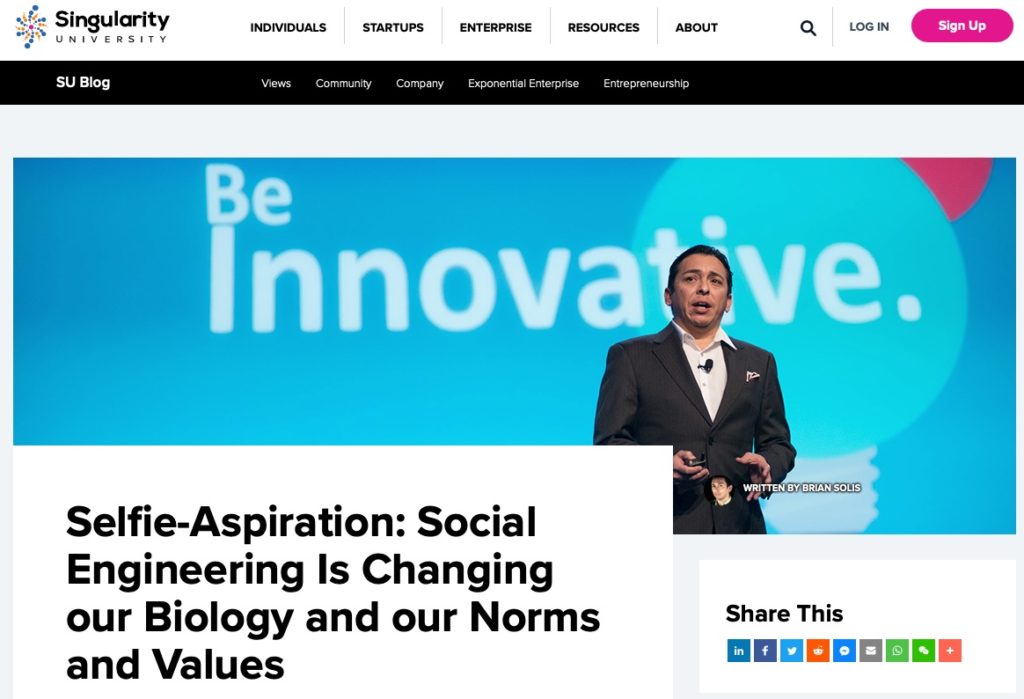
Singularity University is now featuring articles on its SU Blog by Brian Solis. His contributions will focus on exponential innovation, business transformation and digital anthropology. His first three articles include: 5 Laws of Resilient Innovation Ideas are Denied by the Dozen: Why We Need to Celebrate Ideas, Ideation, and Innovation to Succeed Selfie-Aspiration: Social Engineering Is Changing our Biology and our Norms and Values
Is the Golden Age of tech blogging over?
My colleague Jeremiah Owyang sure ruffled some feathers with his post claiming that the Golden Age of tech blogging is over. Aside from being a mentor and a tireless analyst, he’s also a long-time blogger. His words over the years helped blaze the trail for blogging and ultimately the micromedia bonanza that he believes is contributing to the erosion of long-form social prose. In his article, he quotes good friends Loic Lemeur, Ben Metcalfe, Ben Parr, Francine Hardaway, Chris Heuer…
The State of the Blogosphere 2011
Part 14 in a series introducing my new book, The End of Business as Usual…this series serves as the book’s prequel. When you think about social media, what do you envision? Twitter, Facebook, Youtube, Foursquare? If you’re like me, blogs would have made the top of the list. But how can blogs survive in a time when the attention of connected consumers is not only precious, it’s elusive. After all, people can read no more than 140 characters at a…
The Top 10 Marketing Sites for Social Media Marketing Trends
Recently, the Pivot Conference team set out to learn more about the state of social advertising and the future ahead by conducting an industry survey of 230 brand managers, executives, and marketing professionals. We will release the full report during the week of July 25th. Not all of the insights we learned will make it into the final report. However, I will share a few interesting findings as they come up starting with this one… The Top Marketing Sites for…
Are you a content consumer or creator?
You’ll soon learn why I’m posting shorter, but more frequent posts…In the mean time, I wanted to share with you something I’ve been thinking quite a bit about these days. Think about the generation or two before us. A significant portion of free time was spent consuming media. From print to broadcast, everyday people simply digested information and content presented to them. But then, everything changed. We were gifted with the ability to share what we think, feel, and experience,…
The State of the Blogosphere 2010
The question we ask ourselves when examining the state of the blogosphere is whether or not the cup is half full or half empty? Personally, I believe the answer lies in the nature of circumstances. If drinking from the glass, it is then half empty. If pouring, it is half full. With the rise of Twitter, Posterous, Tumblr and other forms of micromedia, many believed that the glass was half empty. Blogging appeared passé as many individuals opted for microblogging,…
The Future of Marketing Starts with Publishing Part 1
I recently called for businesses to broaden their perspective of Social Media from an experimental stage of acting and reacting, to one of learning and leading through intelligence, participation, and also publishing. Creating social profiles and broadcasting tweets and status updates is elementary, whereas creating a meaningful presence through the development and dissemination of remarkable content is judicious. What lies ahead is an inflection point in the maturation of social media, publishing, marketing and communications. And, it all begins with…
What IF We Redefined Influence? The New Influence Factor in Social Media
The role of influence is changing and diversifying and with it, the rules and responsibilities of engagement are also reshaping. While PR, analyst, and investor relations were clear yesterday, the rise of new influencers, tastemakers and authoritative users and customers becomes both pervasive and uncertain. As such, new opportunities for engagement emerge; creating new opportunities for cultivating distributed relationships. However, each new connection requires management, a support infrastructure, including a dedicated host. The democratization of content production, publishing and distribution…
Rumors of the Death of Blogs are Greatly Exaggerated
Source: feministing Each year at Blogworld Expo, Technorati CEO Richard Jalichandra presents The State of the Blogosphere as one of the event’s prestigious keynotes. For those who are unfamiliar with Technorati, it serves as a directory and search engine for the blogosphere as well as a benchmark for the ranking of blogs worldwide. While there has been much discussion about the relevance and even demise of blogs as the statusphere and micro updates gained traction in addition to earning prominence…
PRNews Recognizes PR 2.0 with Nomination for 2009 Blog of the Year
Each year, PRNews hosts an awards gala where they salute the winners and honorable mentions of the PR People Awards, the Hall of Fame Inductees & PR News 15-to-Watch. I am honored to be nominated in the PR Blogger of the Year category along with Tim Haran of Usana Health Sciences and David Westcott of APCO Worldwide. I’d also like to take this opportunity to spotlight all of the nominees across all categories for the PRNews PR People 2009 awards….