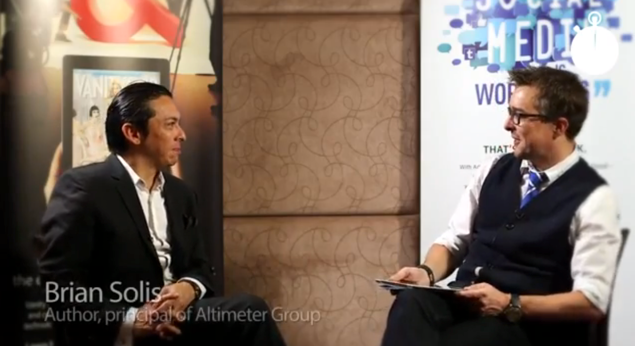
Earlier this year, I had the opportunity to present in London at a special Adobe event to celebrate the launch of What’s the Future of Business: Changing the way businesses create experiences. Immediately following the presentation, I joined Adobe’s Jeremy Waite to shoot an episode of Marketing Minute. As the title suggests, each episode is supposed to last 60 seconds. However, this conversation wrapped just shy of 10 minutes. And, I think you’ll see way. As Adobe explains, “In this…

YOU are at the center of The Conversation Prism
JESS3 and I debuted versions 4.0 and 4.1 of The Conversation Prism (TCP) recently to an overwhelming response. Thank you. The initial post was intended to share the evolution of the popular infographic along with the transformation of the social landscape over all. Over the years, new startups, sunsets, acquisitions, mergers, and shifts in trends and technology have played out in true Shakespearean fashion, which has made for truly dramatic theater.Excietment and turmoil aside, The Conversation Prism is in of…
The 2013-2014 Social Media Landscape [Infographic]
After almost two-and-half years, it is with great pleasure that I officially unveil the fourth edition of The Conversation Prism. Viewed and downloaded millions of times over, The Conversation Prism in its various stages has captures snapshot of important moments in the history and evolution of Social Media. For those unfamiliar with The Conversation Prism, it is an evolving infographic that captures the state of social media, organized by how important social networks are used by professional and everyday…
Please help us update The Conversation Prism v4.0
Even though there are a few imposters out there, The Conversation Prism is still the original and IMHO the most thoughtful visualization of the social media landscape. JESS3 and I introduced The Conversation Prism at SXSW in 2008. Since then, it has undergone three iterations with the last being v3.0. I’ve good news to share. We’re working on v4.0, but we need your help to finish it. We’ve removed and added some categories as well as introduced and deleted many…
Introducing The Conversation Prism Version 3.0
If a conversation takes place online and you’re not there to hear it, did it really happen? On August 5, 2008 JESS3 and I introduced version 1.0 of The Conversation Prism. Today, I’m proud to announce The Conversation Prism Version 3.0. With the introduction of 3.0, our view of the social media panorama is updated and also reflective of the real world that is embracing and organizing the social Web. One of the aspects that make social media so fascinating…
Introducing The Social Compass
An excerpt from my next book… A compass is a device for discovering orientation and serves as a true indicator of physical direction. Inspired by a moral compass, The Social Compass serves as our value system when defining our program activities. It points a brand in a physical and experiential direction to genuinely and effectively connect with customers, peers, and influencers, where they interact and seek guidance online. The Compass features the artistic talents of Jesse Thomas and JESS3 the…
The Conversation Prism: The Landscape for International Social Networking
As Web 2.0 and Social Media became globally pervasive, the landscape proved expansive, overwhelming, and bewildering. It required a social cartographer in order to visualize its grandeur. Thus, in August 2008, the original Conversation Prism was born with the help of Jesse Thomas of JESS3. The Conversation Prism continues to rapidly evolve as social networks emerge, merge, and vanish. In fact, Jesse Thomas and I are already hard at work mapping version 3.0. One thing that we cannot overlook is…
Facebook Swims Its Way into Your Lifestream: What the Facebook news means to you
Shot at Mark Zuckerberg’s 2008 F8 keynote This week Facebook hosted a blogstar-studded event to introduce a more people-focused platform for interacting around your Facebook statusphere in “Twitter time.” Let’s review what this news means to you as a user and as a new media enthusiast. After Facebook’s failed attempt at acquiring Twitter, the company seems to be on a b-line to unite people in an online social graph while connecting them through a dynamic and rapid fire conversation and…
The 2009 Semmys Honor The Conversation Prism
Every year The Semmys nominates the best posts in marketing. Last year, the Social Media Manifesto was recognized and this year, The Conversation Prism was spotlighted. Thank you! When Jesse Thomas of JESS3 and I started to lay the foundation for the Conversation Prism, we realized that it was a much larger task then simply categorizing social networks and placing them within a visually-rich graphic or chart. My goal was to observe, analyze, dissect, and present the dynamics of conversations,…
The Top Social Brands of 2008: What’s Your Conversation Index?
Source Vitrue released a report on the Top Social Brands of 2008 based on an index the company launched last year. The top social brands list is a result of Vitrue’s daily analysis of over 2,000 popular brands. Each day, the team analyzes online conversations on a variety of social networking, blogging, microblogging, photo and video sharing sites. Virtue then applies a series of algorithms to measure the frequency of keyword usage, the size of the social media environment, and…