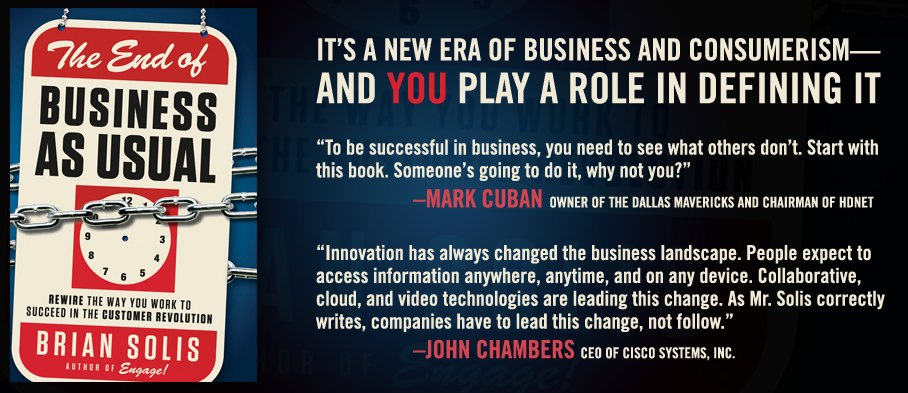
New Zealand magazine Stuff referenced Brian Solis’ second solo book, “The End of Business as Usual” in an article exploring how businesses are forced to change in an era of COVID-19. The book predicted that the evolution of digital customers would disrupt incumbent businesses to the core. While many organizations moved slowly, disruption was thrust upon every company around the world. There is no Almost 10 years ago Brian Solis wrote The End of Business as Usual. The bestseller explored…

The End of Business as Usual Rewire the Way You Work to Succeed in the Consumer Revolution – GetAbstract
For those who don’t have the time to read an entire book, but still need the benefits of doing so, I present to you…GetAbstract. I’m proud to announce that The End of Business as Usual Rewire the Way You Work to Succeed in the Consumer Revolution is now available, along with X, WTF, Engage!, and others! — Before the Internet and social media, consumers who didn’t like a store told a few friends, sent an angry letter or just never…
Sharing a Personal Story – A Rare Glimpse into What Inspires Me and How I Got Here
Believe it or not, I’m a private person. I know it seems ironic. After all, I was one of the early group that worked to bring social media to the forefront in the early 2000s. But, I still tend to not share personal information online. I do however, share my work freely with everyone in the hopes of creating a community of betterment in business, government and society. There are rare occasions however when I do open up to share stories that…
An Intern’s Review of WTF: What’s the Future of Business
One of the little known stories about my previous book, What’s the Future of Business: Changing the way businesses create experiences, is that I wrote and published it after I had started my latest book, X: The Experience when business meets design. While it stands on its own, WTF is technically a companion book to X and can be read as a part 2 of sorts. One of the lesser known facts about WTF, is that it wasn’t even on my docket….
Live Your Brand the Way Your Customers Do
I recently spent some time with PRNews editor Steve Goldstein. As part of a fireside chat we’re doing at the upcoming 20/20 Summit in San Francisco, Steve asked a few questions that lead to a pretty deep conversation. I wanted to share it with you here. Digital Darwinism is Real: Compete for the Future (Compete for You) Now PR News: In your book “What’s the Future of Business?” you suggest that while it’s a good thing that companies are investing…
10 Quotes on The Future of Business
10 quotes by Brian Solis on the Future of Business from Prezly Every now and then, I receive a nice surprise that gives me pause. Today is one such moment. I hope you don’t mind, but I wanted to share it with you. The team over at Prezly put together a wonderful Slideshare that features some key quotes from my last three books Engage, The End of Business as Usual and What’s the Future of Business (WTF). I could only…

A Visual History of Book Trailers by Brian Solis
If you follow my work, you’ve probably learned that I’m becoming increasingly fond of web video. As an author, I am fascinated by the different channels and new media opportunities that have been thrust upon the world of book marketing. Over the years, I often considered how to create book-related videos that provided viewers with something beyond a traditional promo or standard author introduction. While important, they weren’t necessarily conducive for social sharing. A few years ago, I was introduced…
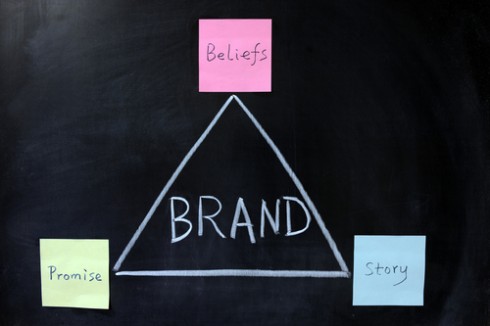
Your Brand is More Important Than You Think: BrandSTOKE’s 9 Criteria for Brand Essence
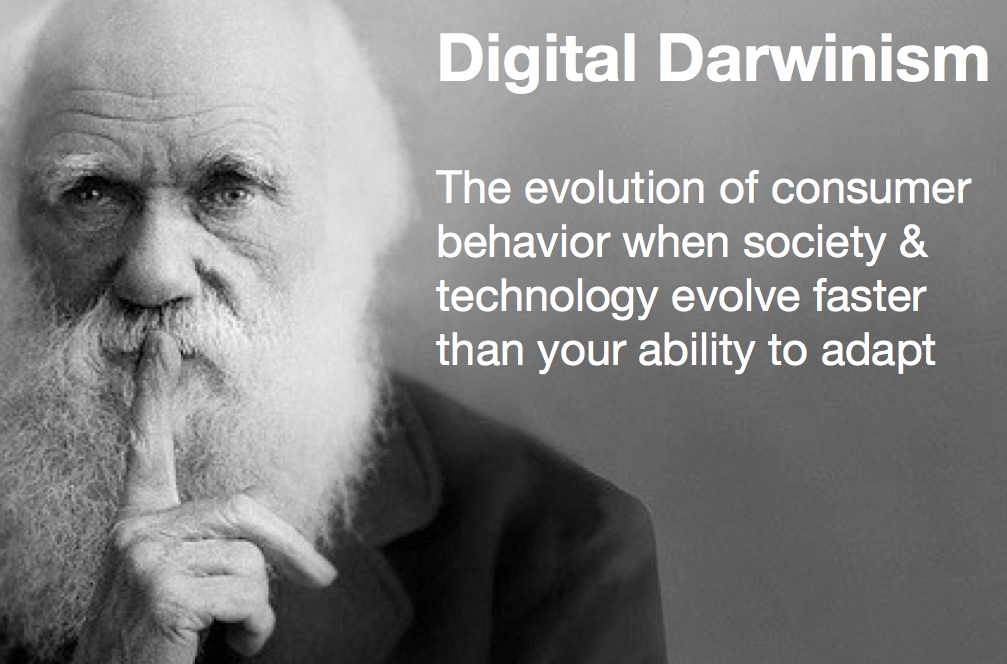
The importance of establishing your brand in the era of Digital Darwinism cannot be overstated. Digital Darwinism occurs when technology and society evolve faster than one’s ability to adapt. Every brand is vulnerable, but no business is too big to fail or too small to succeed. With customers today being increasingly connected, informed, and ultimately empowered, their expectations only escalate. In short, they are more discerning and demanding than ever before. The brand and the brand promise are of paramount…
It’s The End of Business as Usual at B&N on 5th Ave.
I’m in New York getting ready for The Pivot Conference. Shortly before arriving, I was told I needed to visit the Barnes and Noble store on 5th Ave. upon arrival. After several days, I was finally able to make it over and I’m sure glad I did. Wow. The End of Business as Usual is currently gracing the storefront window on 5th Ave.! I proudly took a few moments to sign every copy and while I was there, I talked…
The rise of Generation-C…and what to do about it
I recently had the privilege of presenting at the GDOL Digital Talkfest in Istanbul. The focus of the event was very much in line with my current work. GDOL tracks the new generation of consumers who do everything online and the impact they now have on popular culture, society and ultimately business. I refer to this generation as Generation-C. Prior to my trip, I met with Capital Magazine for an in-depth interview. They asked some very important questions, questions that…