
ChatGPT was the fastest technology to reach 100 million users. In 2022 – 2023, ChatGPT almost single-handedly changed the trajectory of mainstream computing and how people interact with information. Suddenly everyday users could shift between consuming and co-creating data with the assistance of generative AI tools. Though it had been evolving for years, OpenAI captured the zeitgeist with ChatGPT, and everything changed from there. Now in 2024, we’ll see a shift from curiosity to strategic execution. Generative AI will get…
Introducing the GenAI Prism Infographic: A Framework for Collaborating with Generative AI
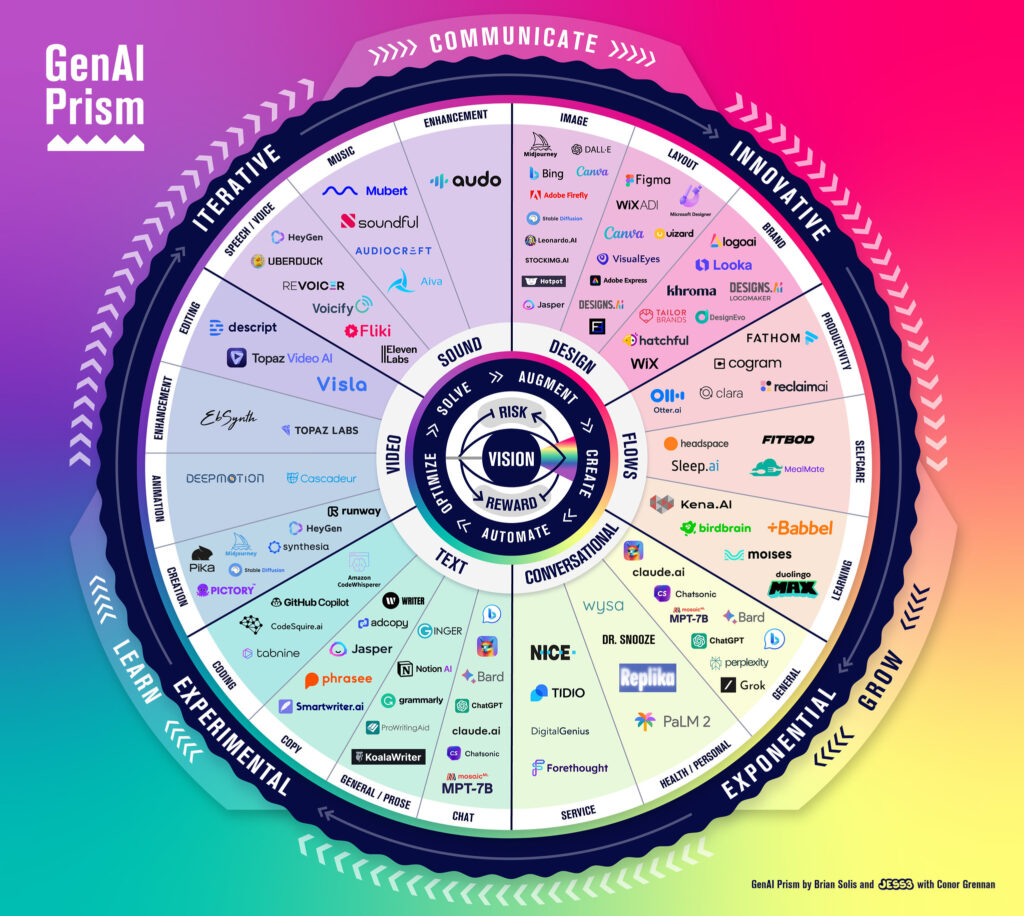
NEWS: Introducing the The GenAI Prism, the single most comprehensive representation of the generative AI universe. JESS3 design studio and Brian Solis, digital futurist and best-selling author, announced the release of the GenAI Prism v1.0 infographic along with Conor Grennan, leading generative AI expert and Dean of Students/Head of GenerativeAI at NYU Stern School of Business. Jeremiah Owyang, Venture Capital Investor at Blitzscaling Ventures, and my friend and former colleague, shared an observation that there are more than 10,000 generative…
Introducing The Ideation Cycle – A Fun Framework for Marketing and Building Movement Around New Ideas
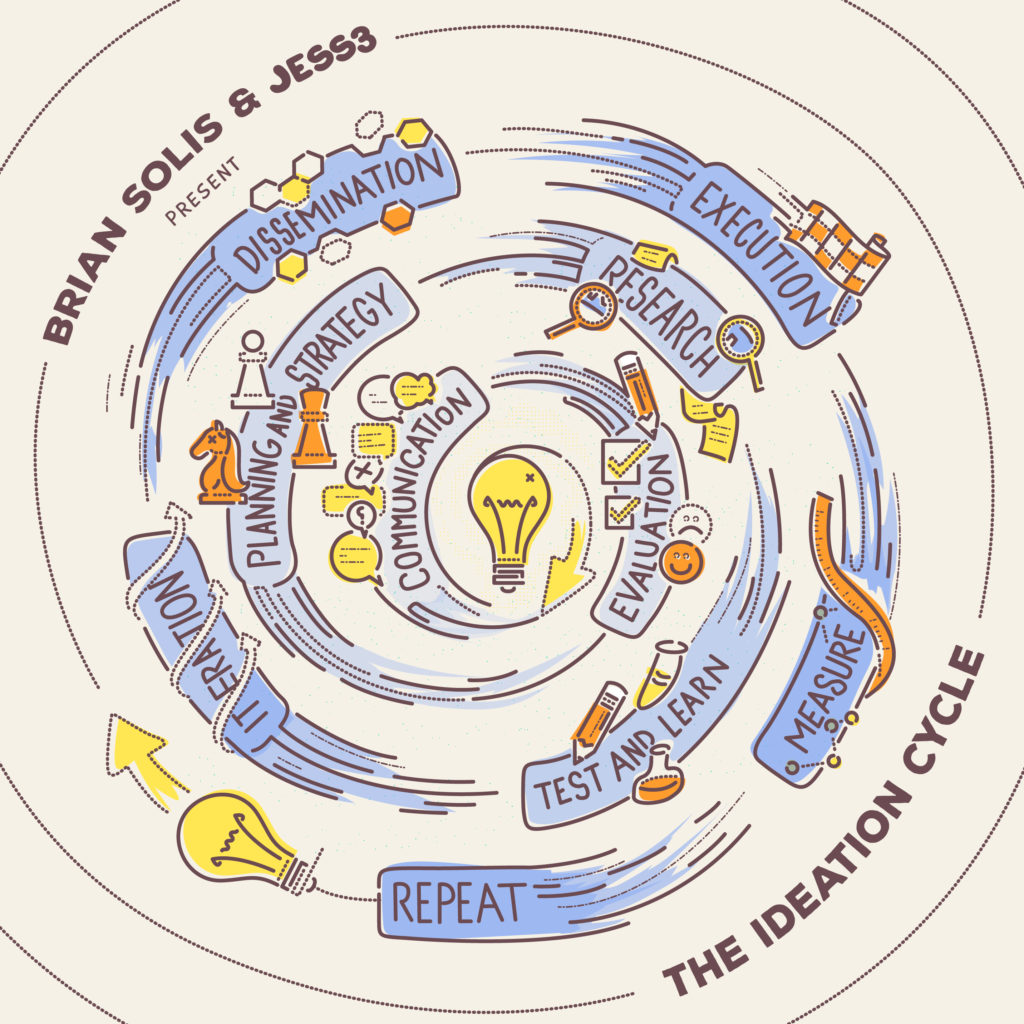
Everyone has ideas. What separates ideation from impact is action, community-building, and creating value. Ideas represent possibilities for alternate futures. Ideation stirs hope and forms pathways to change. But, the idea is just one part of transformation and innovation. It takes a village as they say. And the village must not only believe in the idea, but also believe in mission, the purpose, and the value they’ll experience as a result. In an era of artificial intelligence (AI) and machine…

Speaking To and Through People You Hope to Inspire: Analog-to-Digital Street Flyers That Hit Different
This is the week of SXSW 2021. Even though it’s a virtual event this year, it is still a special community bound by the spirit of entrepreneurship, creativity, ideation, friendship, and tacos (+ BBQ, queso, pedicabs, and late nights!) Since this is a very special week, I wanted to share a story with you that I don’t think I’ve ever talked about. Every year, going back to, 2007 I think, JESS3 and I would legally (on plastic coverings) post creative…
Conversation Prism 5.0: The 2017 Social Media Universe in One Infographic
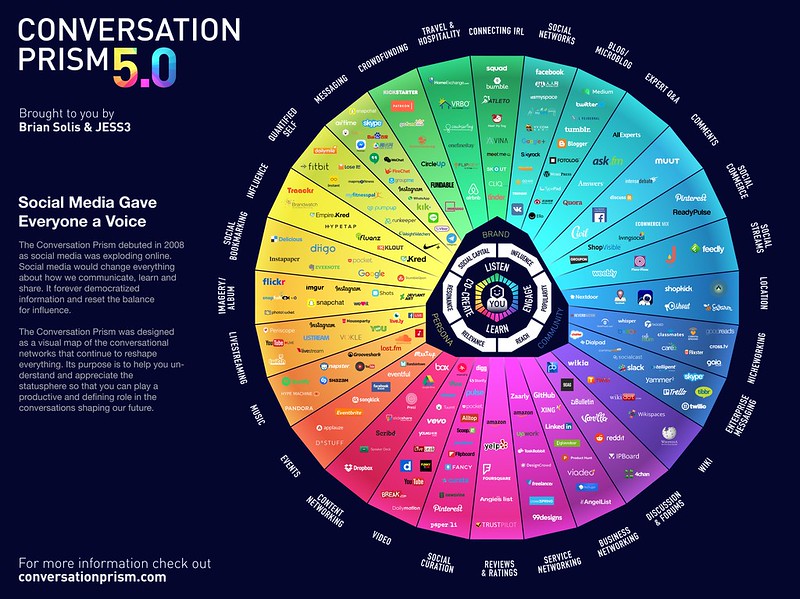
Social media continues to reshape our world and how people connect, discover and share. While some argue that we should drop “social” from the moniker and simply call it “media,” the reality is that social media is only spreading, evolving and becoming more pervasive in our life and work. Every few years, I partner with JESS3 to capture the state of social media visually. The challenge is always great in that social networks and apps come and go, but over…
Please help us update The Conversation Prism v4.0
Even though there are a few imposters out there, The Conversation Prism is still the original and IMHO the most thoughtful visualization of the social media landscape. JESS3 and I introduced The Conversation Prism at SXSW in 2008. Since then, it has undergone three iterations with the last being v3.0. I’ve good news to share. We’re working on v4.0, but we need your help to finish it. We’ve removed and added some categories as well as introduced and deleted many…
Twitter’s Mad Men Moment
Twitter continues to impress its supporters and critics alike. With 100 million active users, one billion Tweets published every day, and a fresh round of funding, Twitter’s monetization strategy continues to mature. In addition to licensing deals for its coveted fire hose and a future revenue stream tied to analytics, Twitter’s blue bird truly flies with the help of its expanding portfolio of Promoted products. The company is now releasing its latest offering, and it’s the most controversial product yet….
Behaviorgraphics: Discovering the “Me” in Social Media
Social media is a deeply personal ecosystem that I lovingly refer to as the EGOsystem. As such, there is a “me” in social media for a reason. It is quite literally a world in which we are at the center of our online experiences, a place where everything and everyone revolves around us. Placing ourselves in the role of this emerging social consumer for a moment, brands, businesses, and media aren’t sure how to see or reach us directly yet….
Click Your Way Through the Twitterverse
Guest post by Laura Fitton (@pistachio), founder, OneForty.com Back in 2009 when @oneforty was a mere gleam in my eye and Twitter for Business was barely understood, our friend and advisor Brian Solis teamed up with @Jess3 to map the newly-exploding Twitterverse. Their 2011 Twitterverse organizes the chaos by function. IF you have time to search through the complex graphic, look up the items, try to discern which tools are right for your business… getting tired yet? That just got a lot easier….
The Social Compass is the GPS for the Adaptive Business
Over the years, I’ve written extensively about the need to extend opportunities in social media beyond marketing and customer service to set the stage for the social business. I believe that the impact lies beyond the socialization of business; it introduces us to a genre of an adaptive business, an entity that can earn relevance now and over time by listening, engaging, and learning. In October 2009, I worked with JESS3 to visualize corporate transparency and authenticity for the release…