
It’s been a bit of a whirlwind since the launch of X. In the last two weeks, I’ve hosted conversations about the promise of experience design in London, Düsseldorf, Oslo, Sydney and Geelong. Somewhere along the Atlantic, I was asked to answer a few questions ahead of my arrival in Geelong for the Pivot Summit by Courtney Crane of the Geelong Advertiser. Thanks to the magic (or curse) of inflight wifi, I was able to make her deadline. But it…
Small Business Survey: Technology a Challenge and Opportunity, Steve Jobs Recognized as Idol
Did you know that the 23 million small businesses in America account for 54% of all U.S. sales? Did you know that small businesses provide 55% of all jobs and 66% of all net new jobs since the 1970s? While big business has eliminated four million jobs since 1990, small businesses added eight million. Why the focus on small business today? It’s National Small Business Week in the United States and to commemorate the occasion, I partnered with Cox Business…
No Business is Too Big to Fail or Too Small to Succeed – Sobering stats on business failures
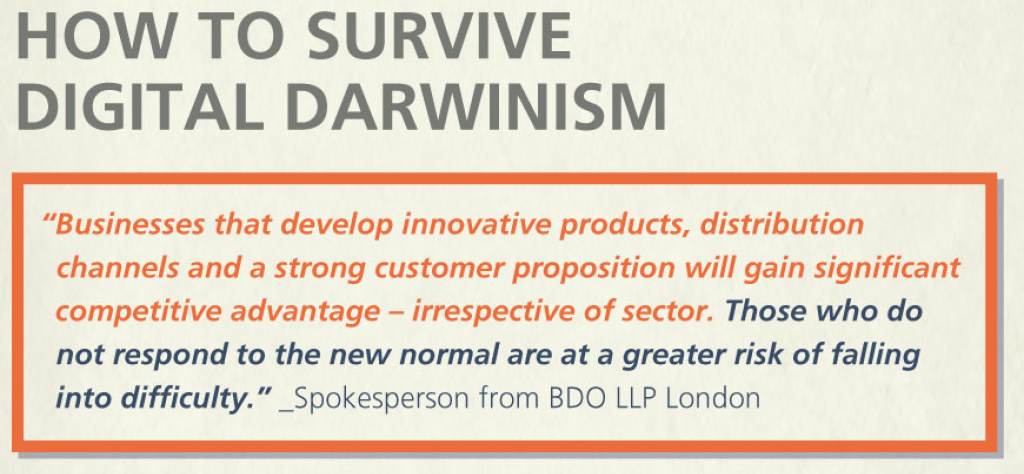
We live in an era of what I refer to as Digital Darwinism, a time when technology and society are evolving faster than the ability of many organizations to adapt. Over the years, I’ve studied how disruptive technology affects consumer behavior and decision-making. I’ve also researched how businesses react (or don’t) to these changes. What I’ve learned is that barring a few exceptional instances of complete ignorance, organizations are open to adaptation if there’s indeed a case made for it…

Small Business Strategy: 10 Trends to Watch
Part of an ongoing series dedicated to small businesses As you read this, the business landscape is shifting right under your company’s foundation. How customers make decisions, how they discover, communicate, and share, how they influence and are influenced, is evolving considerably. In fact, customer behavior is not only changing, it’s fragmenting and opening the door to new touch points. Your business will now have to compete for the customers you know and additionally, a new breed of customers that…
5 Ways Strategic Social Media Can Help Small Businesses
I often write about enterprise organizations and global brands…essentially big businesses. This is the first in a series dedicated to small businesses. One of the biggest misconceptions about social media strategy is that only the big brands and enterprise organizations can afford success. The impression is bigger businesses have unlimited resources, people and budgets to execute on all new ideas. This is simply not true. Like in anything, people are focused on their jobs as they exist and anything new…
Almost Half of Small Businesses Find Customers in Social Networks
In social media, is there truth to the proverb, “seek and ye shall find?” As our experience in new media matures, learning what it is we wish to seek and also accomplish is at the forefront of rapid evolution. Converting questions into objectives is how we grow and succeed. While the opportunities within social media in general are sweeping, one such possibility that’s largely untapped in business social networking is the ability to find customers and prospects as well as…
In Social Media, Engagement Has Its Rewards
One of the most sought after answers in Social Media is whether or not engagement in social networks such as Twitter or Facebook directly correlates to customer acquisition, retention, and advocacy. Before we can earn customers however, we have to recognize that at any given time, there are also prospects. And, prospects require information and confidence in order to make decisions, in your favor of course. The answer to our question lies in social engagement. Prospects are not only searching…
Social Media in Small Business is Anything But Small
In celebration of National Small Business Week… For entrepreneurs, business owners, investors, and consultants, one of the most exciting prospects of social media, lies in the ability to dramatically amplify your visibility and value proposition among existing and potential stakeholders. Social Media finally places small, local and emerging businesses in the spotlight in ways that up until this point, were largely unattainable. New Media is rapidly shifting the landscape of how people find and share information and much of it…
Championing Change from Within
Social Media is as revolutionary as it is evolutionary. It represents an important chapter in the ongoing saga and transformation of new media. Over the years, we’ve witnessed that the 10 stages of social media integration in business are almost always set in motion by an internal champion who is determined and impassioned to engender change from the inside out. These champions emerge from different disciplines and departments and are typically role agnostic. Depending on the organization, champions exist in…
The Socialization of Small Business
Social Media impacts every business, every brand, and in doing so, connects a network of distributed communities of influence, making the world a much smaller place in the process. Small businesses are in fact at an advantage in Social Media Marketing as they can focus on hyper-local activity that can offer immediate rewards or at the very least, the real-time feedback or lack thereof says everything about next steps. A recent survey conducted by Citibank offers a contrary point of…