The first time I wrote about Twitter was March 2007. My, how time and Tweets fly. With 500 million registered users and 250 million Tweets flying across the Twitterverse every day, Twitter has become a fabric of our digital culture. Twitter is now ingrained in our digital DNA and is reflected in our lifestyle and how we connect and communicate with one another. While many struggle to understand its utility or its significance in the greater world of media, it…
Click Your Way Through the Twitterverse
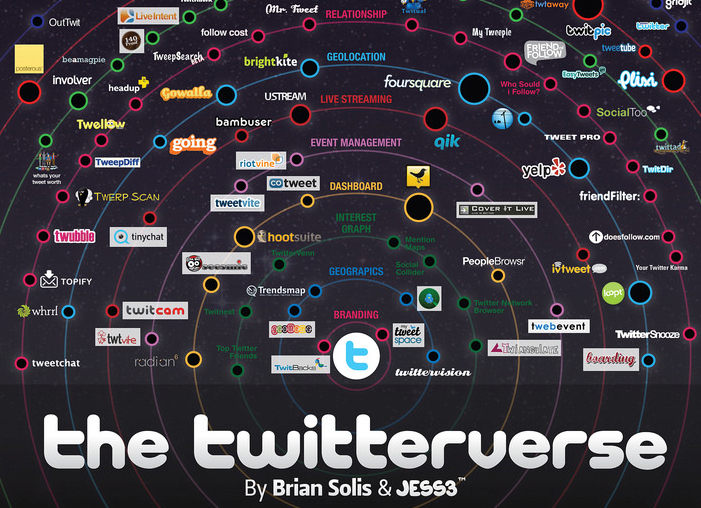
Guest post by Laura Fitton (@pistachio), founder, OneForty.com Back in 2009 when @oneforty was a mere gleam in my eye and Twitter for Business was barely understood, our friend and advisor Brian Solis teamed up with @Jess3 to map the newly-exploding Twitterverse. Their 2011 Twitterverse organizes the chaos by function. IF you have time to search through the complex graphic, look up the items, try to discern which tools are right for your business… getting tired yet? That just got a lot easier….
Exploring the Twitterverse
Happy New Year! Twitter officially launched to the public in July 2006. By 2008, the universe of applications developed to enhance the Twitter experience was boundless. While the ecosystem was burgeoning with apps, the ability to track and manage the apps designed for specific purposes was elusive. I spent the better part of Fall 2008 studying and organizing the available Twitter apps available for new marketing, community management, and customer service professionals. Once organized, I published Twitter Tools for Marketing…
What if Twitter Had an App Store? Now It Does.
In October 2008, I documented months of research and analysis into a full directory of Twitter applications for communications and marketing professionals. In May 2009, I categorized the most applicable and qualified applications, and with the help of JESS3, we published The Twitterverse, a beta map of the Twitter universe that arranged relevant applications in a way that allowed us to see and navigate the landscape more efficiently and effectively. While working on the official release of the Twitterverse, I…
A Pictorial History of Twitter’s Rise to Pop Culture
Every now and then I discover something that is so captivating, that I have to stop what I’m working on to share it with everyone I know. This is one of them. For those veterans who continue to define Twitter’s role in how we communicate, share and learn, those who have recently made its acquaintance, and those just finding their stride, we all linked through common threads and context that pique our curiosity, stimulate our quest for adventure, expand…
Twitter Inspires a Dedicated and Thriving Startup Economy
Twitter continues to amaze us. Its constantly evolving examples of change and connectivity persevere and reinforce how the “little microblog that could” is transforming media and communications while also silencing the most dubious of critics. At the same time, I’m confident that through our pioneering efforts and innovative developments, we also continue to amaze the team behind Twitter itself. As Jack Dorsey shared in his keynote today at the 140 Characters Conference in New York, “Expect the unexpected. Sometimes, be…
Gazing into the Twitterverse
Twitter connects people through a rich and active exchange of ideas, thoughts, observations, and interests in one, highly collaborative and promising ecosystem. The Twitterverse advances micro interaction and connections through an expanding network of applications, engendering the potential for macro reach and resonance online and IRL (in real life). Following the recent debut of The Conversation Prism v2.0, Jesse Thomas (@jess3) and I proudly introduce an alpha version of The Twitterverse. While the landscape for Twitter approaches 1,000 different applications,…
Twitter Traffic Surges to 10 Million: The Demographics Driving the Growth
Twitter continues to defy all those who question its relevance. Exploding from 6 million visitors at the beginning of the year, ComScore released its latest numbers that portray an almost vertical ascent through the end of February 2009, hitting an astonishing 10 million worldwide. Perhaps more interestingly, is the demographics that are fueling the groundswell. According to ComScore, the majority of visitors around the world were 35 years old or older, which match Nielsen’s assessment of those groups representing the…
Twitter Tools for Marketing and Community Professionals
Twitter is nothing short of a phenomenon. At the very least, it connects people to each other through a rich and active exchange of ideas, thoughts, observations, and vision in one, highly conducive ecosystem (known as the Twitterverse). The social fibers that weave together this unique micromedia network is strengthened by the expertise, respect, trust, admiration, and commonalities. These fabrics bind the people who breathe life and personality into the global community as well as fueling the disparate micro communities…