
If you were to look at Social Media the United States and many other parts of the world, you would believe that the world of Social Media was flat, dominated by social continents including Facebook, Twitter, blogs, YouTube, and Flickr. As we zoom in, we visualize other established and emerging social services that depict provinces and outlying settlements of our social atlas.
Upon publishing the original Conversation Prism, which was the culmination of a year’s work documenting and organizing the social web by usage and conversational patterns, the world responded by creating Conversation Prisms specific to each country. I shared several new social maps in “The Landscape for International Social Networking.”
Over the years, other maps emerged that documented leading social networks around the world as well as the social behavior associated within each country. As Social Media is truly global and relationships are truly without borders, I too have spent a great deal of time researching the networks that host conversations relevant to my projects regardless of geographic location.
Italian blogger Vincenzo Cosenza has for the second time, published a visual map that portrays the most popular social networks around the world based on the most recent traffic data (December 2009) as measured by Alexa & Google Trends for Websites.
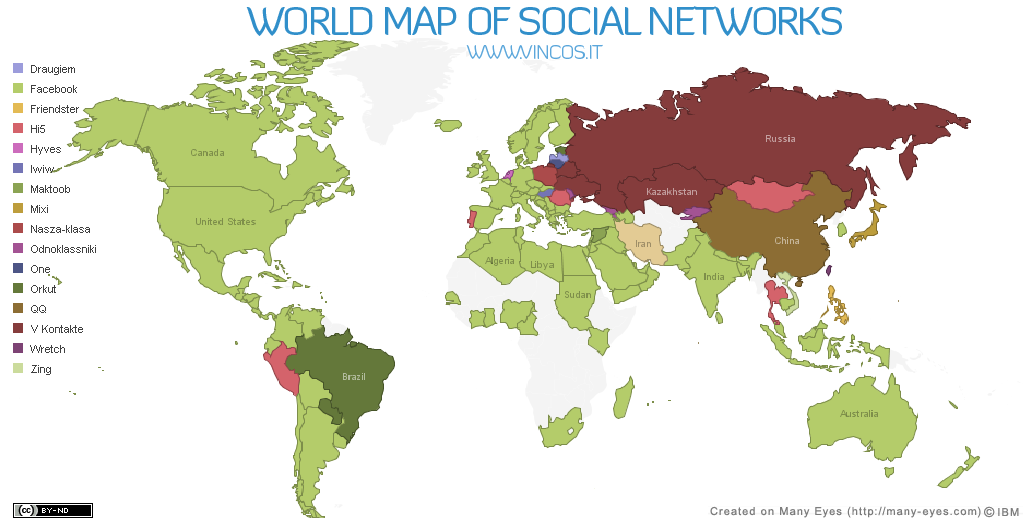
Upon review, it’s clear that Facebook, at 400 million, is truly earning a global audience, which naturally burrows its social roots with every new connection and the connections of connections forged within the network. According to research, Facebook dominates in 100 out of 127 countries measured.
If we were to analyze the top three social networks by what many argue are the top 10 markets for social networking, our view comes into focus and allows us to see where our attention and participation is required in our global efforts.
Australia
1. Facebook
2. MySpace
3. Twitter
Canada
1. Facebook
2. MySpace
3. Flickr
China
1. QQ – 300 million active accounts
2. Xiaonei
3. 51
France
1. Facebook
2. Skyrock
3. MySpace
Germany
1. Facebook
2. StudiVZ
3. MySpace
Italy
1. Facebook
2. Netlog
3. Badoo
Russia
1. V Kontakte
2. Odnoklassniki
3. LiveJournal
Spain
1. Facebook
2. Tuenti
3. Fotolog
United Kingdom
1. Facebook
2. Bebo
3. MySpace
United States
1. Facebook
2. MySpace
3. Twitter
In other parts of the world, social networks that might not have registered previously among leading experts, emerge as candidates when location and society prove paramount in highly targeted, culturally-aware programs.
For example, Google’s Orkut is Brazil’s top social network.
Hi5 is leading in Mexico, Peru, Portugal, Romania, Thailand and Mongolia.
In the Czech Republic, Lide is the network of choice.
Maktoob is the social hub in Libyan Arab Jamahiriya, Oman, Saudi Arabia, Yemen.
South Korea is focusing its dialogue and connections in Cyworld.
Social networking in Guadeloupe and Martinque is concentrated at Skyrock.
Mixi is the leading central station for social activity in Japan.
The leaderboard of those countries not yet friended by or fans of Facebook include:
Hungary – Iwiw
Poland – Nasza-klasa
Philippines – Friendster
Netherlands – Hyves
Lithuania – One
Latvia – Draugiem
Taiwan – Wretch
Zing – Vietnam
The Global Web Index
The race for supremacy in social networking is only part of the story. As in any race, we typically expect a winner to reach an end. However, this competition is absent of finish line and as a result, a true overall winner is beside the point. Many networks will enjoy time in the spotlight until their luster ages and a new framework for engagement lures our friends of friends, our friends, and finally our attention and participation. As consumers, we go where we are not only wanted, but also where we can make an impact.
While we’ve reviewed the top social networks across the social Web, ranked by countries spanning the globe, the balance of the story is represented in the actions that define social media engagement within each network and influenced by the culture of each country of prevalence.
TrendStream analyzed social media activity around the world and captured the results in a stunning infographic.
This graph essentially unravels the ties that bind us and peels back the layers of social networking technologies and platforms to reveal how real people are adopting and engaging in the social web.
The map demystifies how social media is embraced around the world, demonstrating that social computing and collaboration is far from ubiquitous. And, in many countries, how we use social media is much different than how we will use it over time. We’re still in the very early stages of the social (r)evolution..
TrendStream in partnership with Lightspeed Research interviewed 32,000 Web users in 16 countries. As such, the Global Web Index analyzes active social web involvement and then organizes and presents behavior by volume (in millions). Reviewing the Global Web Index and fusing the information with the data included in the World Map of Social Networks, we can get a clear indication of how social behavior defines social networks and to what extent. It’s a goldmine of data for any brand or government agency seeking a more influential form of propaganda (2.0).
Social Web Involvement is categorized as:
Pink – Uploading photos online
Purple – Uploading videos
Blue – Managing a social network profile
Orange – Blogging
Pink – Micro-blogging
Grey – Percentage of population with access to social tools


Presenting the Data
Australia
Leading Network: Facebook
Social Network Profiles: Access= 40% | Users = 5m
Photos: Access = 39.1% | Users = 4.9m
Videos: Access = 11.9% | Users = 1.5m
Blogging: Access = 11.4% | Users = 1.4m
Micro Blogging: Access = 5.6% | Users = .7m

Brazil
Leading Network: Orkut
Social Network Profiles: Access= 59.6% | Users = 17.9m
Photos: Access = 54.9% | Users = 16.2m
Videos: Access = 34% | Users = 10.2m
Blogging: Access = 20.7% | Users = 6.2m
Micro Blogging: Access = 14.2% | Users = 4.3m

Canada
Leading Network: Facebook
Social Network Profiles: Access = 46.2% | Users = 10.2m
Photos: Access = 40.9% | Users = 9m
Videos: Access = 14.9% | Users = 3.3m
Blogging: Access = 10.6% | Users = 2.3m
Micro Blogging: Access = 5.1% | Users = 1.1m

China
Leading Network: QQ
Photos: Access = 60.3% | Users = 117.7m
Blogging: Access = 46% | Users = 89.7m
Videos: Access = 28.7% | Users = 55.9m
Social Network Profiles: Access = 27.3% | Users = 53.2m
Micro Blogging: Access = 21.3% | Users = 41.5m

France
Leading Network: Facebook
Social Network Profiles: Access = 29.3% | Users = 11.2m
Photos: Access = 27.5% | Users = 10.5m
Blogging: Access = 9.5% | Users = 3.6m
Videos: Access = 9.5% | Users = 3.6m
Micro Blogging: Access = 3.8% | Users = 1.4m

Germany
Leading Network: Facebook
Social Network Profiles: Access = 32.7% | Users = 13.9m
Photos: Access = 31.6% | Users = 13.4m
Blogging: Access = 10% | Users = 4.3m
Videos: Access = 8.5% | Users = 3.6m
Micro Blogging: Access = 5.7% | Users = 2.4m

India
Leading Network: Facebook
Photos: Access = 63.9% | Users = 22.4m
Social Network Profiles: Access = 57.5% | Users = 20.1m
Videos: Access = 36.2% | Users = 12.7m
Blogging: Access = 34% | Users = 11.9m
Micro Blogging: Access = 24% | Users = 8.4m

Italy
Leading Network: Facebook
Photos: Access = 43.3% | Users = 9.1m
Social Network Profiles: Access = 35.8% | Users = 7.6m
Videos: Access = 20.9% | Users = 4.4m
Blogging: Access = 19.4% | Users = 4.1m
Micro Blogging: Access = 12.3% | Users = 2.6m

Japan
Leading Network: Mixi
Blogging: Access = 24.5% | Users = 15.9m
Photos: Access = 19.5% | Users = 12.7m
Social Network Profiles: Access = 14.9% | Users = 9.7m
Micro Blogging: Access = 8% | Users = 5.2m
Videos: Access = 5.7% | Users = 3.7m

Mexico
Leading Network: Facebook
Photos: Access = 52.9% | Users = 6.4m
Social Network Profiles: Access = 40.2% | Users = 4.8m
Blogging: Access = 25.6% | Users = 3.1m
Videos: Access = 22.1% | Users = 2.7m
Micro Blogging: Access = 13.7% | Users = 1.6m

The Netherlands
Leading Network: Hyves
Photos: Access = 37% | Users = 4.8m
Social Network Profiles: Access = 36.2% | Users = 4.7m
Blogging: Access = 10.1% | Users = 1.3m
Videos: Access = 10% | Users = 1.3m
Micro Blogging: Access = 3.5% | Users = .45m

Russia
Leading Network: V Kontakte
Photos: Access = 59.9% | Users = 18.8m
Social Network Profiles: Access = 48% | Users = 15.3m
Videos: Access = 39.6% | Users = 12.6m
Blogging: Access = 18.3% | Users = 5.8m
Micro Blogging: Access = 12% | Users = 3.8m

South Korea
Leading Network: Facebook
Photos: Access = 53.1% | Users = 14.9m
Blogging: Access = 39.9% | Users = 11.2m
Videos: Access = 19.5% | Users = 5.5m
Social Network Profiles: Access = 15.6% | Users = 4.4m
Micro Blogging: Access = 14% | Users = 4m

Spain
Leading Network: Facebook
Photos: Access = 39.4% | Users = 7.4m
Social Network Profiles: Access = 35.8% | Users = 6.7m
Blogging: Access = 17.2% | Users = 3.2m
Videos: Access = 16.2% | Users = 3.1m
Micro Blogging: Access = 7.5% | Users = 1.4m

UK
Leading Network: Facebook
Social Network Profiles: Access = 42.6% | Users = 15.9m
Photos: Access = 38.2% | Users = 15.7m
Videos: Access = 11.5% | Users = 2.4m
Blogging: Access = 8.4% | Users = 5.5m
Micro Blogging: Access = 5.3% | Users = 4.6m

USA
Leading Network: Facebook
Social Network Profiles: Access = 44.2% | Users = 92.1m
Photos: Access = 42.6% | Users = 79.2m
Videos: Access = 15.3% | Users = 23.5m
Blogging: Access = 12.8% | Users = 17.6m
Micro Blogging: Access = 7% | Users = 10.7m

Observations
In 50% of the countries included in this study, online photo sharing dominated the list of social media applications. It is also among the oldest of social services within the included mix.
44% of the countries in this survey embrace online profiles in social networks suggesting that their personal brand, whether for engaging in personal or professional interactions, is becoming increasingly important.
81% shared photos and online profiles as the top 1 and 2 activities with the exception of Japan, China, and South Korea where blogging displaced social profiles as a top application.
94% of countries reported that micro-blogging (think Twitter) were among the least pervasive with the exception of Japan, where it ranked fourth – just below social network profiles and above video.
China’s digital footprint is massive, defined by the incredible volume of content creators and the contribution of their social objects. As the study reports, “due to the inward looking nature of China’s internet economy combined with the language mean that this volume of content does not impact the broader Internet.”
TechCrunch also observed a tremendous opportunity for Facebook in Russia. Leading network Vkontakte.ru is in many regards, a Facebook clone. However, its facsimile of a growing global network is also indicative of a potential deal. Vkontakte is owned in large part by Digital Sky Technologies, a company which also owns a noteworthy stake in Facebook. A deal of this magnitude would further socialize Russian and other worldwide users under one truly global social network.
As we examine opportunities for global social networking, we are reminded that anthropology and sociology play critical roles in observing and documenting behavior, supporting cultures, and established governances for dictating how content, information, and relationships forge and flourish. In order to ensure relevance and earn significance within networks, we must think locally when examining opportunities globally. In addition, as culture and behavior shifts across countries, they also establish a new dynamic within each Social Networks creating a universal population that adapts what they know to what they learn and experience.
Connect with Brian Solis: Twitter, LinkedIn, Tumblr, Facebook
—
Pre-order the next book, Engage!

—
Click the image below to get the current book, poster, or the iPhone app:


—
Image Credit: ShutterStock


I'm student of media management in university of Tehran in Iran. I search the article about behavior of google user. can you help me?
Mohammad, what kind of behavior do you seek to understand? What they are searching for? Try Google Trends or the Keyword suggestion tool.
Tanx, I want to know Google user usually read 5 or 10 page of search result
or
They click in which links if two link is similar
or
proportion of use Google web with Image or news
even
which link placed in Top page by Google (rating)
Germany even has got its own Conversation Prism > http://davaidavai.com/2009/09/21/germany-the-so…
Excellent. I've featured it here as well: https://www.briansolis.com/2009/09/the-conversat…
Wow! I wasn't aware they existed for so many locations. Cool.
Wow! Another great, clear presentation of data.
On looking at it, I'm wondering about the underlying meaning of higher percentages of access in some countries — India, for example — than in the United States. What does this mean in terms of the future?
I also wonder about the statistical significance of a 32,000-person testing size when Facebook alone has more than 300 million users. Is this a true picture of the Web, or has the small percentage of users skewed the results?
We have to work togethermake our country more relevant on the map.
There aren't many long blog posts that I can actually make it through (beyond 500 words) – this and many of your research-driven posts are certainly the exception to the rule – nice work, Brian!
I particulary respect that comment you made mid-post, “However, this competition is absent of finish line and as a result, a true overall winner is beside the point.” I especially like that you say, “As consumers, we go where we are not only wanted, but also where we can make an impact.” This is something we all have to evaluate and consider as we get into our social strategies for business here in 2010 and beyond.
Thanks for sharing…I'll certainly spread the word about this particular conversation!
Matt, appreciate the comment. Over the years I've felt that someone needed to provide the depth necessary to lead change from within. Thank you.
Might have missed something but it looks to me like, basically, it's all about Facebook 🙂
very interesting analysis of global conversations…
Thank you Dawn!
In China, a more accurate Facebook equivalent would be Renren (formerly known as Xiaonei) and Kaixin001. I believe in Mexico Facebook has overtaken H5.
QQ is very interesting in that it managed to monitize its platform v quickly… some lessons there for FB
I was speaking with my colleague Mio and neither of us can believe China's blogging numbers. That can't be right can it?
well apparently so, according to 2007 report from the China Internet Network Information Center: http://www.cnnic.net.cn/html/Dir/2007/12/27/495…
hey Brian,
it would be interesting to see the growth rate of respective sites as well. Hungary is often mentioned among the places where a local social network is more popular than Facebook, however, this is misleading – iwiw is stagnating to say the least, with most users hardly ever logging in, while Facebook is growing more and more rapidly.
Thank you for such enlightment. if there is any data for Turkey, please dm.
Brian,
Such great blogs! I think this is an interesting break down of the data. It's interesting to look at the different countries and see whether the differences can be looked at from developed versus developing countries, the cultural differences are immense. For instance, you talk about Brazil which is the leading country in social media… however they use Orkut which changes the dynamic of social media. What are your thoughts on this? Thanks so much for the blogs they really are great reads!
Thanks for this update @BrianSolis.
As I learned in my 20 years there, Japan has a tendency to do things all at once, en masse. Their foray into social media has been recent but enthusiastic. I expect to see those percentages increase but there are language issues with true international participation.
I utilized top social media site rankings by country last year for a client who was sure they wanted their TV personality talent to have a profile on “every important English social media site”. Fortunately, BEBO has “lifestream” functionality which gives it some native updating.
Great data. I belive in nordic countries is Facebook, Twitter and Myspace – but also linked-in, slideshare and Flikr. 1/3 of the population i sure is on Facebook now. Now business is aproaching Facebook.
You need to come back Brian and update us;)
Well done, great job.
regards
Tor
I believe that as with search engines, winner will take the pot in social media. There will be one very large network and then smaller sites that are way behind. It makes more sense to be long to one large network than into several smaller ones.
Thanks Brian, excellent analysis.
Interesting to see how much growth potential there is in China, India and Russia given the user numbers vs total population. Access is still obviously an issue (and in many other countries) but assuming that continues to increase it will be fascinating to see these numbers in 3,4,5 years time.
Great post Brian! I've been reading your blog for some time now and I'm always thoroughly impressed with both the topical relevance of your posts and the depth of your analysis. You are truly a digital superstar! Keep the great posts coming and I'll keep sharing your insights with everyone I can.
Another thorough and insightful post Brian. Thanks for taking the time to put this together. Extremely interesting stuff.
I wonder if any other social networks in the past have had the kind of international dominance that facebook is enjoying today.
It's also interesting that uploading pictures would be more popular that social network profiles…the main purpose of these sites.
Brian,
I admire your depth, use of data/analysis and objectivity. Put another way, you provide “news we can use,” and not just top of mind commentary.
In this case, you've provided a data driven reinforcement of an age-old business adage: “Think globally, act locally.” This mindset is probably even MORE true in the social environment, an environment of conversations among communities and affinities.
I wonder if this is more an issue in the U.S. than elsewhere in the world. It's ironic how, on the one hand, we recognize how social media breaks down the global barriers yet, on the other hand, we fail to recognize that in other parts of the world, different “flavors” are preferred to what we here in the U.S. tend to consume. Clear implications for any multinational player wishing to maximize their efforts. We here in the U.S. seem most guilty of not grasping this.
Thanks for another great post with some real “meat” to chew on. Your blog remains in my “must read” list.
Cheers,
Ted
Ted, well put…”Think globally, act locally.” Thank you!
This is very eye openning but also a little scary. Why? because Facebook has major security issues. Once you are signed up there your infomation is theirs for life. You can park your profile but NOT delete it. We have adviced many not to use facebook. Yes it flies in the face of the norm but in the long run there is a “Big brother” factor that may come back to haunt you.
This is an excellent research snapshot of the state of social media as it exists at a certain point. As you mentioned the evolution of this medium is so complex; i.e. marketing, security, which way the wind blows, world and geographical events, etc. While analytics are fine, the pulse is a more difficult thing to get a feel for. Trends tell some of the story but is the concern the message or the messenger?
Brian, as always, thank you for presenting the data in wonderful infographics. Very insightful!
Nice analysis for Social Media.
Those are very interesting statistics. It's good to see that Facebook is the number one choice throughout most countries! You're analysis on why consumers use these social media vehicles are very interesting. Thank you for your insight!
I really enjoyed reading this post. It really puts in perspective just how widely spanning Facebook is and comparatively how big China's online community is. To have Facebook be the biggest with 400 million and China have 300 million social network profiles without having Facebook as its leader is crazy to think about. Also I really like Brian's observation and analysis of the world moving to globalization in the form of social networking.
Hi Brian.
I’m curious to know if you’re planning an update for 2011. This is an awesome analysis that I’ve used a lot, but in social media time a year is an eternity. I’m sure the cyberscape has changed significantly.
Thanks.
Courtney Hunt
I do know that when I get access to data on this subject, I will indeed write about it.
Can’t wait to see how things have and have not changed. In the meantime, I (like so many people) will continue to refer to this post.
I really liked your article and I shared with my friends in my facebook account ..
That was a great piece of information, I enjoyed reading it.
Excellent Article Brian….I’ve been taking some time to study China’s QQ network. It is extremely massive. However, this isn’t stopping Jack Welch for advertising his 2011 China tour. I think this is great and I look forward to seeing other Americans step out of their comfort zone to advertise here. Google translator certainly helps:)