
On July 22nd 2010, Facebook officially announced that it had surpassed 500 million users around the world. This significant achievement represents a significant milestone for Zuckerberg and Co. as well as for social networking and more importantly for global societies overall.
To celebrate this achievement, Facebook released Facebook Stories, a new service to spotlight user stories from around the world and the impact Facebook has had on their lives.

In Mark Zuckerberg’s words, “We’re launching a new application called Facebook Stories where you can share your own story and read hundreds of others, categorized by themes and locations around the world.”
Highlights shared in Zuckerber’s blog post about the service include:
– Ben Saylor, a 17-year-old high school student, who turned to Facebook to organize a community effort to rebuild the Pioneer Playhouse, the oldest outdoor theater in Kentucky, after it was damaged by floods in May.
– Danish Prime Minister Anders Fogh Rasmussen, who, during his time in office, would go jogging with 100 of his fans from Facebook.
– Holly Rose, a mother in Phoenix, who credits a friend’s status message telling women to check for breast cancer with her being diagnosed in time to treat the disease. She used Facebook for support during treatment and became a prevention advocate herself.

Facebook Around the World
Facebook is the leading social network in 111 out of 131 countries as recently analyzed by Vincenzo Cosenza.
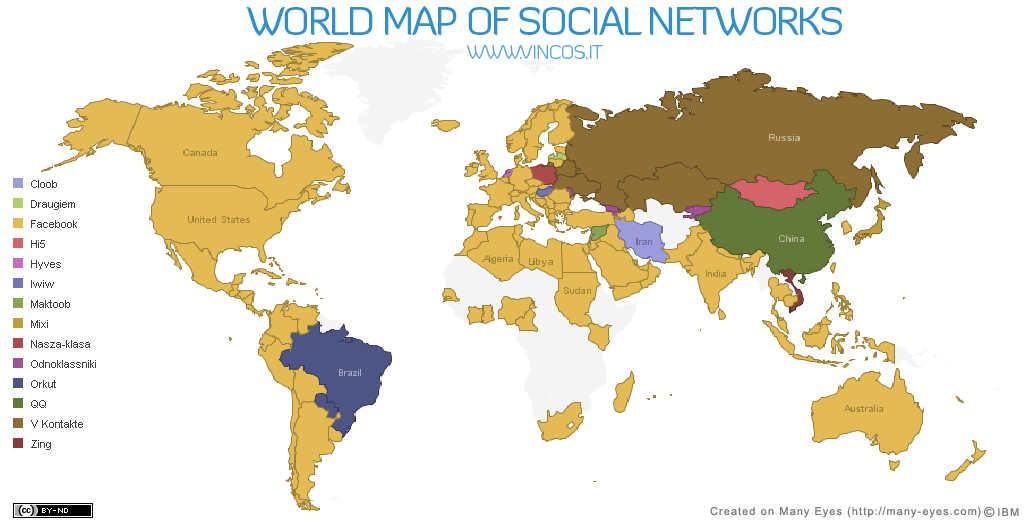
If Facebook was a country, it would rank third, just behind the People’s Republic of China and India and roughly 190 million ahead of the United States, over 200 million greater than Indonesia, and 300 million greater than Brazil.

If we examine the breakdown of Facebook’s population, we’re presented with an interesting picture of worldwide adoption (source).
Top 15 Countries by Number of Users
1. United States – 125,881,220
2. United Kingdom – 26,543,600
3. Indonesia – 25,912,960
4. Turkey – 22,552,540
5. France – 18,942,220
6. Italy – 16,647,260
7. Canada – 15,497,900
8. Philippines – 15,284,460
9. Mexico – 12,978,440
10. Spain – 10,612,820
11. India – 10,547,240
12. Argentina – 10,452,040
13. Columbia – 10,226,920
14. Germany – 9,948,700
15. Australia – 9,151,280
To offer a bit of balance, at the end of the population list, Anguilla Facebook ambassadors rank at number 187 with 6,420 users.

When we examine worldwide Facebook activity however, we’re presented with a different picture. According to O’Reilly Research, Asia and Africa represent high growth regions.

O’Reilly also reports the age demographics of users in each country. The share of users age 18-25 is higher outside the U.S., but notice the representation of users 35 and older.

The Human Network
Facebook’s mission is to help make the world more open and connected and indeed it is changing how people interact online. The “Facebook” stories shared through this new service highlight very human ways that social networking is changing people’s lives and I believe that is the bigger story here. Over time, I have borrowed Cisco’s tagline, “The Human Network” to demonstrate how digital social networks were contributing to a new era of society that transcends online and offline relationships and how we foster and interact with each.
The discussion as to whether or not Facebook is the largest social network in the world is no longer relevant. Facebook, along with other prominent and emerging networks such as Twitter, Foursquare, and hundreds of other networks, has forever changed the way individuals connect and share with one another, adapting cultures and customs, dissolving borders, and uniting disparate cultures. The world is indeed becoming a much smaller place.
From Dunbar’s Number to Social Graph Theory
Many experts continue to cite British anthropologist Robin Dunbar’s famous number of 150 (estimated). Dunbar’s number represents the maximum number of social relationships we as individuals can manage to a stable extent. If we look at Facebook data, the average person maintains a social graph of 130. However, I believe that we will eventually see a shift from relationships to relations as a result of social networking.
The average number will grow from 130 to double over the next 1-2 years as individuals expand their social graph from those we know in first-degree relationships and those we care to know, second and third-degree relationships.
While we’ll still place greater emphasis on important offline and online relationships through active interaction, we will also consume, react to, and share thoughts, insights, and content with those individuals that move us intellectually and emotionally.
As a result, Facebook will eventually need to revisit its current friend limit of 5,000. For those individuals who hit that ceiling, their only option is to move from a profile to a “brand” page. Doing so however, shifts the dynamics of the relationship and resulting interaction from a peer-to-peer or horizontal axis to a top-down or vertical grade of communication.
We will focus shifting attention on the sub-networks within our social graphs that are separated by themes and context. These social “nicheworks” will result in higher engagement and participation as the core of these discussions, individuals are rewarded for their participation with intelligence, a platform to share their perspective as well as new requests for connection. Expect to see Facebook create grouping functionality to draw lines between interaction within these nicheworks to ensure that we do not cross the streams within our main social graph.
So, how has Facebook changed your world?
Connect with Brian Solis on Twitter, LinkedIn, Tumblr, Google Buzz, Facebook
___
Please consider reading, Engage!: It will answer your questions…

___
Get Putting the Public Back in Public Relations and The Conversation Prism:

___

No comment on data privacy and Mr. Zuckerbergs behaviour on that? Only “the human network”? Blue eyes, baby got blue eyes …
I currently working on a privacy report that encompasses Facebook and Twitter…stand by. Like borders, privacy concerns are too eroding.
I really like this Facebook stories addition to the site – kinda cool to see how Facebook has changed each of our lives. Thanks for sharing!
I really enjoy reading your work every day and am glad to hear your working on a privacy report. There are a lot of ways in which our privacy needs are generational, however, the exploitative marketing potential of gathering all your friends info and other data, etc.. I think puts too much information in the sellers' hand. It may be too late already, but we have to draw a line in the sand, if people are only looked at as consumers, at least here in the US, it fosters continuing underlying problems for us economically. MY 2 cents.
I do believe we are the last generation to know privacy as it was. With that said however, Facebook is not alone in this…I think there is more power and resolve if we place the onus of responsible “publicy” on ourselves
http://en.wikipedia.org/wiki/Publicy
Thanks as always, Brian, for your excellent in depth analysis!
Scott
Thanks Scott!
Very good analysis, Brian. There is so much detail in this one single report that each of the stats can be built into a story of its own. Look forward to more!
error
Brian… love the article and graphs (as always)! Can you please explain what you mean by the last sentence: “Expect to see Facebook create grouping functionality to draw lines between interaction within these nicheworks to ensure that we do not cross the streams within our main social graph.”
Thanks!
-Monique
Hi, yes…essentially you will be able to guide which groups of individuals within your social graph see particular updates…as defined by themes and interests.
This article really demonstrates how much the world has changed due to Facebook and other social media channels. It truly has made the world small.
Great analysis. Can't wait for the privacy report you're working on.
Regards,
Petra
Brian article and graphs are exceptional model of information vision intellect and clarity you are freely sharing hope we can bounce off each others ideas make for a better world in technology information sharing. MOAI Statue (Super Natural) and I too expect to see Facebook monitor these market driven niche works and new age business professional approaches to ensure that we do maximize streams within our main social graph what I interpret as meaning to utilize the networks of your business with others and of course our own Tidal Electric Energy Company plans to expand exponentially product exposure popularity and focus people to modern technologies driven entrepreneurs in and ever so changing world! John Wanoa Auckland New Zealand.
wow,
Thanks for the statistic, it will come in handy.
Nice paper Brian! By the way – just keen on knowing – whatever happened to Myspace?I remember it was quite popular a few years ago (not here in India though).Its also fascinating to see Facebook overtaking Orkut in India so soon.
Regards
Nilay (Mumbai , India)
Great to hear my POV by someone else-Facbook, Twitter, Linkedin, all are excellent tools on taking the personal to a whole different level. Thanks!
This is a good and interesting report. I am not convinced, however, that large-scale use of Facebook by several countries means that the world is opening more. Do you have data about how many people are connecting across country barriers? And more, beyond cultural barriers? It seems to me that this simply shows that people are creating more relationships within their already existing spheres. That's not the same as making the assertion that digital social networks have changed the way we adapt cultures and customs, dissolve borders, and unite disparate cultures.
Zuri, all of my theories are rooted in data…where it is today and where it will be tomorrow will be interesting to observe.
Definitely about humanity
Just realized the rules of comment! lol So here is mine with the adjustments in place!
I agree this report is very interesting! Just go’s too show how fast CyberSpace has made it possible for all nationalities across the globe too place their piece of info & interests on any site whatever the guise maybe!
But the communication part is really only just taking off! Yes! I know how many emails are sent out everyday but it’s still not the ideal way too stay in touch! Be honest how many emails that you receive do you actually read, not many I bet except from the one’s you deem important! Well now we have Video Email! Now that is a concept that will over the next few years replace the email as we know it today! I am from the old school & guess what I envy the youth of today! Why! Cos the net & sites like Facebook has & will change the way we all communicate! Don’t get left behind if you wanna stay ahead of technology then do what I do! Yes I use Video Email for business, pleasure & for simply staying in touch! Take a look at my info too find out what I mean! Have a great Xmas & New Year every one! Boy this would be allot easier too do via a video message! Believe Me! lol All this typing take’s time with one finger LOL My best wishes & regards too all reading these comments!
Just realized the rules of comment! lol So here is mine with the adjustments in place!
I agree this report is very interesting! Just go’s too show how fast CyberSpace has made it possible for all nationalities across the globe too place their piece of info & interests on any site whatever the guise maybe!
But the communication part is really only just taking off! Yes! I know how many emails are sent out everyday but it’s still not the ideal way too stay in touch! Be honest how many emails that you receive do you actually read, not many I bet except from the one’s you deem important! Well now we have Video Email! Now that is a concept that will over the next few years replace the email as we know it today! I am from the old school & guess what I envy the youth of today! Why! Cos the net & sites like Facebook has & will change the way we all communicate! Don’t get left behind if you wanna stay ahead of technology then do what I do! Yes I use Video Email for business, pleasure & for simply staying in touch! Take a look at my info too find out what I mean! Have a great Xmas & New Year every one! Boy this would be allot easier too do via a video message! Believe Me! lol All this typing take’s time with one finger LOL My best wishes & regards too all reading these comments!
Really interesting Blog post. The way of communication has indeed changed a lot due to Facebook and other Social Media platforms. Amazing that now you only have to click on a button and someone else on the other side of the world can receive it. The world indeed.. has become very small!
hello
To unsubscribe frokm the mailing listing, send an e-mail to whatwg-unsubscribe@ from
thhe address you need to unsubscribe, and then reply to thhe affirmation e-mail you obtain.