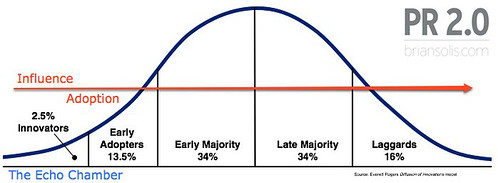
Seems that even the shiniest applications on the Web also face the same growing pains as any product, no matter where it resides on the adoption bell curve.
While many widely speculated the total number of new users who were introduced to Twitter as a result of the now infamous race to 1,000,000 followers, we do know that the number seems to hover between 500,000 and 1.2 million. When compared to the estimated existing user base of ~5 million heading into the race, the final number represents a significant spike in visibility, trials, and subsequent adoption. Irrespective of the exact number, believe that the culture of Twitter is forever influenced as it will with every big event.
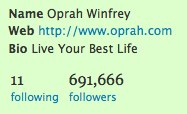
Oprah Winfrey’s followers have skyrocketed to 691,000 as a result of her televised tweet. She follows 11 people.

Ashton’s follower count no longer needs media attention as it seems to be on auto-pilot now. He follows 137.
Robert Scoble made an interesting point recently, “She (Oprah) got at least 300,000 by being on the recommended follower list, not organically.”
His point alludes to something we must consider. While the “Oprah Effect” is profound, is Twitter and its experiential value easily discernible by mainstream consumers?
While its traffic spikes appear significant, the true question is, what happens after new users create accounts and explore the service without direction or guidance?
Nielsen is reporting that Twitter’s growth may indeed face hurdles based on current numbers that document follow vs. follow through.
According to the report, over 60 percent of new Twitter users fail to return the following month, creating a retention rate of only 40 percent. This isn’t an isolated event. Over the last year, Twitter has struggled with user retention, averaging roughly 30 percent carry over from month to month.
Neilsen also explored other popular social networks on their rise to mass adoption.
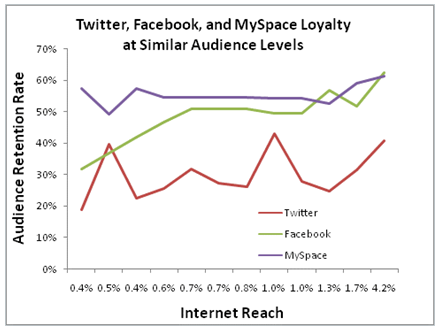
Facebook and MySpace retention rates were twice as high during their phases of dramatic growth and only continued to escalate to the nearly 70 percent both enjoy today. Keep in mind that Facebook has surpassed 200 million active users.
Whether or not you agree with the results, there are associated realities with its current state, age, appeal, and barriers to adoption.
It’s in the way that you use it.
Your experience is defined by those whom you follow.
Indeed, the potential market for “egocasting” is finite. The audience for self-promotion is limited in its patience. An ongoing popularity contest wears even the most persistent. And surely, Twitter is much more than a customer service channel for people to vent about product and service issues only to have companies save the day. The culture needs a supportive ecosystem of people and applications that define and propagate productive interaction. Perhaps Twitter’s simplicity was its greatest catalyst and now potentially its most formidable barrier to reach the critical next stage of evolution. Twitter, along with the community, must demonstrate the value of micro updates and dialogue in order to provide long term value and and ensure resilience for all parties. Adding clever, centralized insight, instruction, and information in addition to recommended people to follow will serve as a companion to those new users who will not take the time to read the instructions and use cases that are globally dispersed across the Web.
Helpful Posts on PR 2.0:
– Twitter Flutters into Mainstream Culture: The New Competition for Attention Starts with You
– Online Reputation and Brand Management Starts with Identity
– The Social OS, The Battle Between Facebook and Twitter is the New Mac vs. PC
– The Domino’s Effect
– The Conversation Index
– A New Search Engine for Twitter
– Social Media Influences Buying Decisions
– Is Social Media Recession Proof?
– Twitter Traffic Surges to 10 Million
– The End of the Innocence
– The Social Effect and Disruption Theory
– Putting the Public Back in Public Relations is Now Available
– Twitter and Social Networks Usher in a New Era of Social CRM
– The Human Network = The Social Economy
– In the Statusphere, ADD Creates Opportunities for Collaboration and Education
– Humanizing Social Networks, Revealing the People Powering Social Media
– Social Networks Now More Popular than Email; Facebook Surpasses MySpace
– I Like You The Emerging Culture of Micro Acts of Appreciation
– The Ties that Bind Us – Visualizing Relationships on Twitter and Social Networks
– Make Tweet Love – Top Tips for Building Twitter Relationships
– The Battle for Your Social Status
– Twitter Tools for Communication and Community Professionals
– Is Twitter a Viable Conversation Platform
Connect with me on:
Twitter, FriendFeed, LinkedIn, Tumblr, Plaxo, Plurk, Identi.ca, BackType, Social Median, or Facebook
—
Subscribe to the PR 2.0 RSS feed.

—
Now available:

—
pr pr+2.0 pr2.0 public+relations marketing advertising interactive social+media socialmedia brian+solis social media media2.0 media+2.0 2.0 smo social+media+optimization marcom communication publicity twitter nielsen facebook myspace




I’d argue that Twitter has always had this problem.
Even the most fervent Twitter users, today, went through a typical hype cycle curve. Posts started with “Finally signing up for Twitter” to “I should update more often” to crickets chirping for weeks/months to “Going to try Twitter again” which more often than not turned into more active use.
This problem, I would argue, has ALWAYS been there. It’s simply that that cycle was a great deal less interesting when it was occurring with the early adopter crowd. 🙂
P.S. Grammar geeking “alludes to” not “eludes to.” 😉
Couple thoughts:
A lot of people sign up to Twitter without really getting it. I signed up over a year ago, I think, and didn’t really get into it for several months.
So there may be some lag between sign up and fervent user.
Also …
Twitter is probably the least likely of the big three (including Facebook and MySpace) to a connector of people you *already know* … meaning that it will likely be harder to keep users that sign up if their “first life” friends aren’t there too.
Twitter has many minuses yet. But it’s simpliness gives the posibily to the users to create, develope, implement.
I was thinking tonight at a twitter tool I could use to talk and enlarge audiences on the social web. May be a general social web tool (facebook, twitter, etc.)
For example: Twitter for a multi-language audience. If you’re from x you receive the x1 msgs, if you are from y you receive only y1 msgs, etc. This way I can talk to people from different corners of the world without sending them messages that they are not interested in or cannot understand. Big companies could use this, users could use this too.
Andrei Sava
http://www.andreisava.eu
I read a funny blog about “twitter enlightenment” today that made me laugh, here is the link – 10 Steps to Twitter Enlightenment.
Brian – great post. I wonder if the lack of knowledge of how to effectively use tools such as Twitter is the culprit to poor retention rates. How many times have we heard people who are not on Twitter say things like “I don’t have time to be on that”, or “I’m not interested in knowing what people are having for lunch”.
OK, then follow the people who provide relevant, useful information! And if you spend 15 minutes on Twitter per day, you can effectively build a core audience of engaged followers, essentially providing a broadcast channel for you or your brand to distribute information.
I recently ran a quick study to see who was actually paying attention on Twitter and measured the response rate to a “useful” post. http://bit.ly/OuvQ6
Sweet!
While the pundits and the analysts will obsess over whether the Nielsen numbers captured, measured, and reported its findings on Twitter retention accurately and responsibly, they will end up missing the very point of the discussion. Which is this: Is there something about Twitter – in the way that relationships are cultivated and sustained– that makes Twitter inhabitants struggle more to survive and thrive than in Facebook?
Regardless of whether Nielsen missed one or another thing in its measurement of Twitter retention, what the results will show, at the end of the day, is that Twitter does have higher attrition among its users.
Reason is, it’s just harder to survive and thrive in a community where the value of your persona is not in the asset of your profile (as in the case of Facebook), but rather the currency of your conversation and the worth of the information you bring to the shared table of the community.
In a way, as social media pushes us further forward into the future at speeds we hardly fathom, Twitter brings us back to the olden times of Plato and Aristotle when words had meaning.
The follow vs. follow through argument is, at its core, a study in the competition going on between means of communication and meaningful communication. As our lives are increasingly consumed by Facebook pages, IM, Twitter, RSS feeds, Digg Thumbs Up’s, url shorteners, embedded HTML, emoticons and hyperlinks, there is little doubt about the premium placed on timely information. It has reached a point where the value of information seemingly diminishes in direct proportion to how old it is. As if an article written six months ago might well as be ten years old.
This tendency will only increase as we hurtle towards a real-time web. FriendFeed has launched the world’s first real-time, live streaming, social media service that is set to revolutionize all media. Yet as people constantly and seamlessly update their “lifestream”, I wonder about the role of meaningful communication?
The funny – and yes timely – Flutter April Fools joke (below) parodied our growing obsession with instantaneous information, exposing the growing misunderstanding that the newness of a means of communication automatically makes that communication meaningful.
The important distinction, as Zeus Jones points out, is that while real time information loses value over time, timeless pieces grow in value.
When you consider brands also rely on an emotional connection with their customers to motivate their behavior, this confusion can be costly. Of course, a meaningful connection isn’t always timeless but the same limitations apply. Hoping to generate trust, interest or loyalty in 140 characters alone is as misguided as a guy wheeling out his best one-liner at a bar. Brands must use a composite of media to build an effective relationship with their customers, rather than see social media as an end in itself. Even when a brand, its products or social entrepreneurship becomes the focal point for conversation it must also play the overarching role of “aggregator and curator”, as Joseph Jaffe asserts, “to provide a place where consumers can see the conversations pulled together, engage with the brand, hear the story in the brand’s voice”.
A means of communication is not an end in itself. It exists to create a connection that enables us to recognize ourselves in others. If our daily exchanges are reduced to a teeming sea of quips, asides and blunt reductions, we simply enlist ourselves in the service of data tracking. As if our lives were some enormous marketing focus group and our communication ticks for empty boxes.
When communication becomes a shooting gallery, the first casualty is dialogue that adds meaning to our lives. As both marketers and consumers, we would be foolish to let this happen. Not wonder we have trouble holding on to so many people.
Very good post.
Did you read Aimee Greeblemonkey’s more sarcastic take on Twitter celebrities?
Celebrity Is As Celebrity Does(She is the one who turned me on to your site.)
The low retention rates don’t surprise me. I reckon Twitter is just experiencing a ‘next big thing’ top of the bell curve popularity that will fall away.
At only 140 characters max there’s not enough space to keep people coming back.
It’s more of a referrer to other things than a destination.
I know that Ashton Kucher and Oprah may be getting over the one million mark but, apart from them, who’s really able to boast those kinds of numbers?
For me, a well written and insightful blog is much more of a draw and something I can get more involved with.
Food post Brian, as always. There’s some debate around the numbers, in particular the difficult of tracking activity from third party clients. But there’s no doubt that a lot of new users, those who may have joined on the heel of celeb twitter campaigns especially, must have a very different experience than us old-timers.
It might make sense to divide user practices and twitter use cases into personal, social, and public. The latte being the newest, social being the most common, and personal being a mode tweetdeckers get into as twitter becomes an open chat channel.
The public use case speaks to a kind of ambient intimacy around celebrities and big name brands, and almost looks like an extension of the mass media into social media. That mass media disrupt social media is ironic but it’s a fact. I would think that a lot of new users will churn out if they don’t get conversational and social after first joining twitter. Ego casting may be a questionable cultural pastime, but it beats the ego inflation or extension that’s at the heart of the follower game!
It’ll be interesting to see where this goes. I’m loving the new interconnectedness w/ fbook inside of twitter clients. Would be interesting to hear your thoughts on that!
cheers!
adrian
I’m not really surprised with the low Twitter retention rate.
The tool is especially effective when continuous updates are needed, like sports events or emergency situations. But for ordinary people it is not an easy thing to tweet regularly, because of its less interactive aspect compared with Facebook or other social media.
However, I think mobile devices have something to do with the future of Twitter. Recently I did a survey among college students for my assignment, and 58 percent answered that they use a mobile device as a tool to access social media. The number is likely to go up as technology advances and that trend might help Twitter to keep up its retention rate. Like text messaging, the microblogging may flourish with mobile devices.
Transferring my comment from Facebook to this post instead.
Cool numbers, but don't they contradict the Harvard Business Review report from yesterday? Overall retention of Twitted is fairly poor and your avg. only seems to come back once every month. As a consequence, 90% of all activity on Twitter is accounted for by a mere 10% of all users.
Link to the report http://blogs.harvardbusiness.org/cs/2009/06/new_twitter_research_men_follo.html
Well , the view of the passage is totally correct ,your details is really reasonable and you guy give us valuable informative post, I totally agree the standpoint of upstairs. I often surfing on this forum when I m free and I find there are so much good information we can learn in this forum!
multi-cavity